The marketing tech stack is always evolving. Marketing automation software enables improved efficiency with various features, from customer segmentation to campaign management.
What’s the marketing automation industry market size? What are the adoption rates of marketing automation, and what benefits does it bring to businesses? Continue reading as we’ll cover answers to these questions with these recent marketing automation statistics.
Here’s what you’ll find on this page:
- Marketing Automation Industry Revenue
- Leading Players in the Marketing Automation Software Industry
- Marketing Automation Budget Changes
- Top Channels Where Marketing Automation is Used
- Top Benefits of Marketing Automation
- Marketing Automation and Customer Data Platform Integration
Marketing Automation Industry Statistics
In 2026, marketing automation is steadily growing, with spending reaching billions every year.
This section presents key statistics to show market automation revenues, top players in the industry, and expected budget changes on automation among marketers.
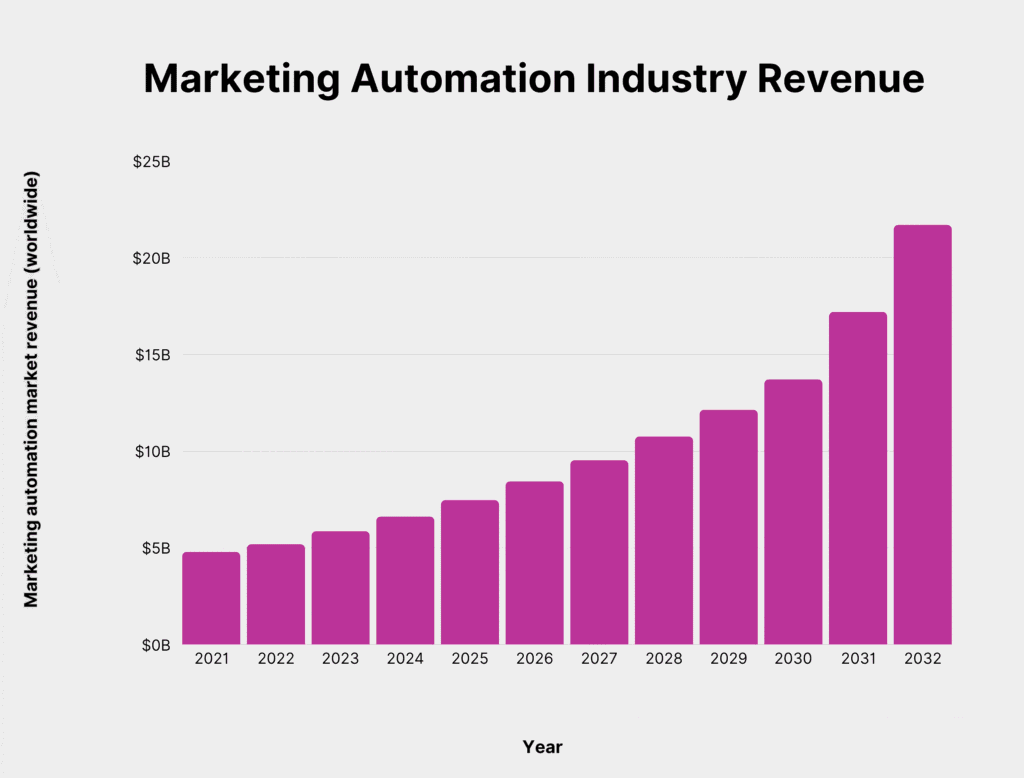
- Between 2026 and 2032, the worldwide marketing automation industry revenue is forecasted to grow by 62.4% from $8.44 billion to $21.7 billion – Statista
| Year | Marketing automation market revenue (worldwide) |
|---|---|
| 2021 | $4.79 billion |
| 2022 | $5.19 billion |
| 2023 | $5.86 billion |
| 2024 | $6.62 billion |
| 2025 | $7.47 billion |
| 2026 | $8.44 billion |
| 2027 | $9.53 billion |
| 2028 | $10.76 billion |
| 2029 | $12.14 billion |
| 2030 | $13.71 billion |
| 2031 | $17.2 billion |
| 2032 | $21.7 billion |
- Revenue of marketing automation solution vendors is forecast to reach $6.6 billion in 2026 (up from $2.9 billion in 2020) – Frost & Sullivan
- Around 68% of surveyed marketers expect an increase in their budget for marketing automation for the upcoming year – Ascend2
| Marketing Automation Budget | Share of marketers |
|---|---|
| Increasing significantly | 14% |
| Increasing moderately | 54% |
| Staying the same | 21% |
| Decreasing moderately | 9% |
| Decreasing significantly | 2% |
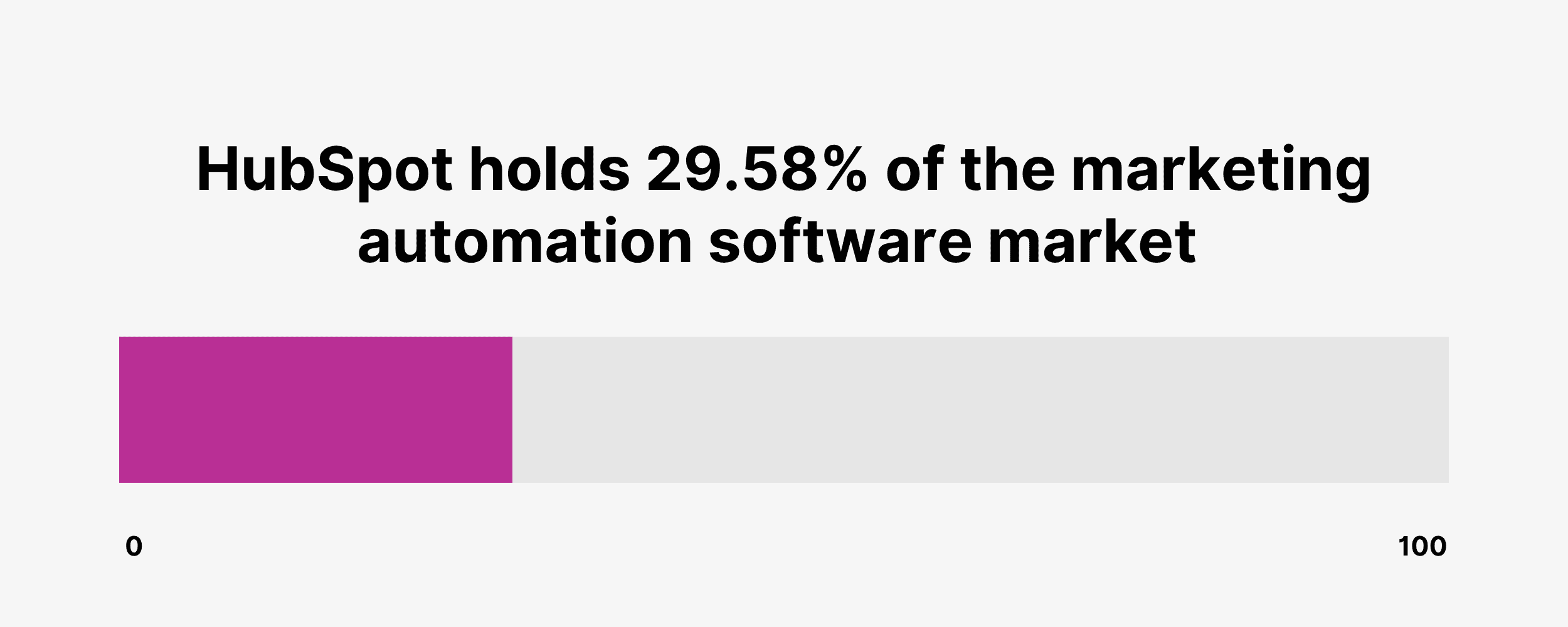
- HubSpot dominates the marketing automation software market, holding a market share of 29.58%. Other commonly used marketing automation tools include RD Station (9.25%), Welcome (7.38%), All In Marketing Cloud (6.87%), and Cheetah Digital (6.86%) – Datanyze
- As of March 2026, at least 454 companies provide marketing automation software solutions – G2
Marketing Automation Usage and Performance Statistics
Marketing automation software is widely used as a part of an effective marketing tech stack.
This section highlights key insights into current adoption and planned usage of marketing automation and its impact on helping achieve business objectives.
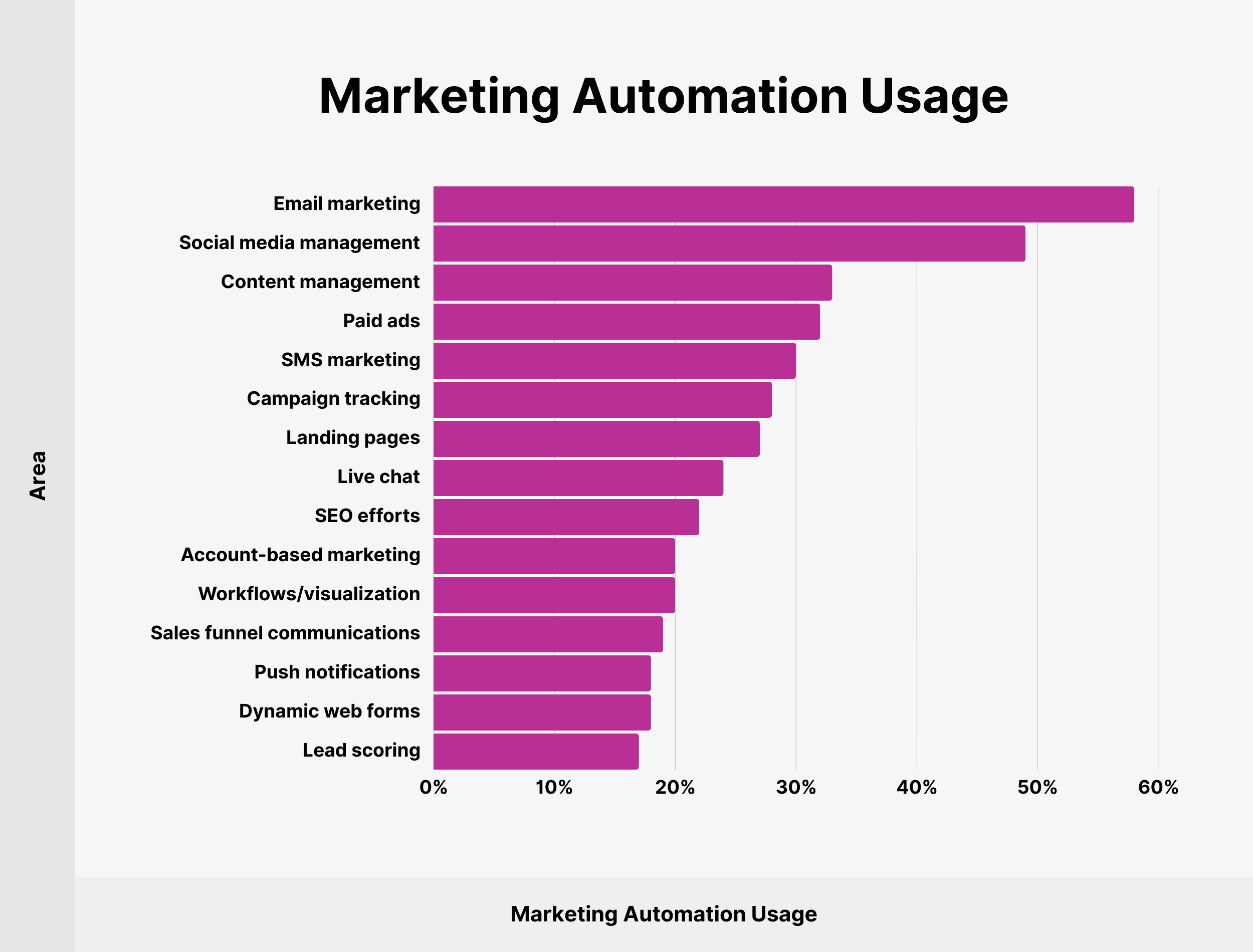
- Email (58%), social media management (49%), and content management (33%) are the most reported areas for currently using marketing automation – Ascend2
| Area | Marketing Automation Usage |
|---|---|
| Email marketing | 58% |
| Social media management | 49% |
| Content management | 33% |
| Paid ads | 32% |
| SMS marketing | 30% |
| Campaign tracking | 28% |
| Landing pages | 27% |
| Live chat | 24% |
| SEO efforts | 22% |
| Workflows/visualization | 20% |
| Account-based marketing | 20% |
| Sales funnel communications | 19% |
| Push notifications | 18% |
| Dynamic web forms | 18% |
| Lead scoring | 17% |
- 29% of surveyed marketers are planning to implement marketing automation for social media management and paid ads. Another 28% claim they will be adding marketing automation to email marketing programs – Ascend2

| Area | Planned Marketing Automation Usage |
|---|---|
| Social media management | 29% |
| Paid ads | 29% |
| Email marketing | 28% |
| Landing pages | 21% |
| SMS marketing | 21% |
| Content management | 20% |
| Campaign tracking | 18% |
| Live chat | 18% |
| Push notifications | 17% |
| Account-based marketing | 16% |
| Workflows/visualization | 16% |
| SEO efforts | 15% |
| Dynamic web forms | 14% |
| Sales funnel communications | 13% |
| Lead scoring | 9% |
- Optimizing overall strategy and improving data quality are top goals for improving marketing automation, according to 37% and 34% of B2B and B2C marketers surveyed, respectively – Ascend2

| Primary Goal for Improving Marketing Automation | Share of Marketers |
|---|---|
| Optimize overall strategy | 43% |
| Improve data quality | 37% |
| Identify ideal customers/prospects | 34% |
| Optimize messaging/campaigns | 31% |
| Increase personalization | 30% |
| Decrease costs/drive efficient growth | 21% |
| Decrease automation across the customer journey | 19% |
| Integrate technologies/data | 15% |
| Increase employee adoption/usage | 13% |
- Around 41% of marketers report that their customer journeys are “mostly automated” or “fully automated” – Ascend2
| Extent of Marketing Automation across the Customer Journey | Share of Marketers |
|---|---|
| Fully automated | 9% |
| Mostly automated | 32% |
| Partially automated | 59% |
- 30% of surveyed marketers strongly agree with the statement that their “marketing automation platform makes it easy to build effective customer journeys” – Ascend2
| “Marketing Automation Platform Makes It Easy to Build Effective Customer Journeys” | Share of Marketers |
|---|---|
| Strongly agree | 30% |
| Somewhat agree | 59% |
| Somewhat disagree | 10% |
| Strongly disagree | 1% |
- About 1 in 4 (26%) of marketers say their multi-channel marketing strategy is fully or mostly automated. Another 22% claim it’s not automated at all – Ascend2
| Extent of Multi-Channel Marketing Strategy Automation | Share of Marketers |
|---|---|
| Fully | 5% |
| Mostly | 21% |
| Partially | 29% |
| Very little | 23% |
| Not at all | 22% |
- Pricing is considered a key factor by 53% of marketers when deciding on a marketing automation tool. Ease of use (54%) and customer service (27%) are regarded as the other top factors driving automation tool purchase – Ascend2

| Factors Driving Marketing Automation Solution Purchase | Share of Marketers |
|---|---|
| Price | 58% |
| Ease of use | 54% |
| Customer service | 27% |
| Customization options | 24% |
| Integration capabilities | 22% |
| Breadth of features | 21% |
| Depth of features | 19% |
| Data visualization/analytics | 13% |
| Streamlined onboarding/training | 11% |
| Data consolidation capabilities | 10% |
- Only 18% of B2B marketers state they use marketing automation that’s integrated with a customer data platform (CDP). Another 42% say they use B2B marketing automation but don’t have CDP in their current tech stack. Other 40% have both B2B marketing automation and CDP, but they aren’t integrated – Adobe
Marketing Automation Benefits Statistics
Marketing teams can greatly improve their effectiveness through the use of automation software, which offers a number of benefits, from improving customer experience to enabling better use of marketing budgets.
- Improving customer experience (43%), enabling better use of working hours (38%), and better decision making (35%) are the most commonly reported advantages of using marketing automation among surveyed marketers – Ascend2

| Advantage of Marketing Automation | Share of Marketers |
|---|---|
| Improves customer experience | 43% |
| Enables better use of staff time | 38% |
| Better data and decision-making | 35% |
| Improves lead generation and nurturing | 34% |
| Enables better use of the budget | 33% |
| Increases personalization options | 24% |
| Increased ability to measure important metrics/KPIs | 23% |
| Aligning marketing efforts to adjacent departments | 21% |
- Around 2 in 3 (66%) surveyed marketing professionals state that their current marketing automation is “somewhat successful” in helping to achieve marketing objectives. Another 25% of respondents say it’s “very successful”. Only 9% of marketers report no success from their marketing automation efforts – Ascend2
Conclusion
We hope you enjoyed this list of marketing automation statistics.
We frequently update this list of statistics. So feel free to check this stats page later for new insights.
The post 15 Key Marketing Automation Statistics appeared first on Backlinko.