
Limited search volume doesn’t mean limited opportunity.
Your entire target market might only search for your solution a few hundred times per month.
High-volume advertisers can test 50 headline variations in a week, while you’re still waiting for your tenth conversion of the quarter.
Most niche advertisers try to use the same strategies that work for high-volume accounts. That’s a mistake.
Google’s automation needs data, and niche markets don’t generate enough searches to feed it. This mismatch either kills performance or prevents results altogether.
This guide shows what actually works when search volume is low and conversion timelines stretch across months.
Why low-volume markets break Google Ads playbooks
Niche businesses face two distinct scenarios:
- You own your brand space: When someone searches your company name, product, or service, you show up organically. Your brand terminology is distinct. Think patented technology, unique category positioning, or specialized services where you’ve built thought leadership.
- You get washed out: Your keywords overlap with bigger competitors, adjacent industries, or generic products. A luxury pet brand competes with mass market pet supplies. A niche SaaS tool shares keywords with enterprise platforms. You’re constantly fighting keyword pollution.
Your strategy changes dramatically based on which scenario you’re in.
Remember, Smart Bidding strategies like Target ROAS and Maximize Conversion Value require at least 30 to 50 conversions per month to function effectively.
Most niche industries don’t reach these thresholds solely from search traffic.
If they do, they’re burning through budget getting a ton of leads (often low quality) at high CPL/CPA just to collect data. Not many can afford that.
But automation isn’t off the table. You just need to feed Google signals differently.
Dig deeper: How to tell if Google Ads automation helps or hurts your campaigns
Signal stacking when search volume is low
Google’s AI learns from every conversion signal, not just keywords.
When search volume is low, build signals from multiple sources.
Start with offline conversion tracking
Phone calls, CRM entries, and deals closed months after the initial click all count if you track them properly.
Use Google’s Data Manager API to sync sales data back to Google Ads.
Every uploaded conversion strengthens Smart Bidding.
Upload Customer Match lists
Even 500 quality email addresses give Google enough pattern recognition to find similar audiences.
A list of customers who’ve spent $10,000+ each beats 10,000 newsletter subscribers.
Use audience signals strategically
Layer in-market audiences, affinity audiences, and demographics into Performance Max in observation mode.
This doesn’t restrict delivery; it teaches Google who converts.
As Jyll Saskin Gales details in her work on audience targeting, the key is using custom segments to reach people based on their recent searches and site visits, rather than relying on broad demographics.
If you own your brand space, signal quality matters more than volume.
Your customers have specific job titles, visit specific websites, and search specific technical terms.
Build custom audiences around these behaviors.
If you get washed out by similar keywords, you need negative audience signals as much as positive ones.
Exclude affinity audiences that align with your keyword competitors but not your actual customers.
Dig deeper: 5 Google Ads tactics to drop in 2026
Campaign structure for small markets
Running only Search campaigns is a mistake.
Google’s AI Overviews now appear on roughly 16% of queries, with navigational queries increasingly intercepted. You need visibility across multiple surfaces.
Start with Search, not Performance Max
PMax needs conversion data to work, and not just any conversions.
You need at least 30 conversions that are actual paying customers or qualified leads, with an emphasis on qualified leads.
When you do launch PMax, use audience signals heavily and monitor where your budget actually goes using the Channel Performance report.
If you own your space, PMax works well once you have data.
If you’re fighting keyword pollution, you need aggressive negative keywords and brand exclusions to prevent budget waste.
Add Demand Gen for awareness building
Your prospects might not know solutions like yours exist.
Demand Gen campaigns reach people on YouTube, Discovery, and Gmail before they’ve searched for your category.
Don’t judge Demand Gen by last click conversions. It creates awareness that shows up as branded searches weeks later.
This matters especially if you’re competing with larger brands, as you can reach prospects before they fall into competitor keyword traps.
Protect your brand terms
Even if you rank organically, run a small exact match campaign on your brand.
Competitors steal clicks.
If you own your space, you can pause this during slow periods.
If your terminology overlaps with competitors, this is critical because you get washed out easily, and organic SEO can’t always do its job. Keep it running constantly.
Dig deeper: Google Demand Gen campaigns: When to use them and best practices
Get the newsletter search marketers rely on.
MktoForms2.loadForm(“https://app-sj02.marketo.com”, “727-ZQE-044”, 16298, function(form) {
// form.onSubmit(function(){
// });
// form.onSuccess(function (values, followUpUrl) {
// });
});
Match types and keyword strategy
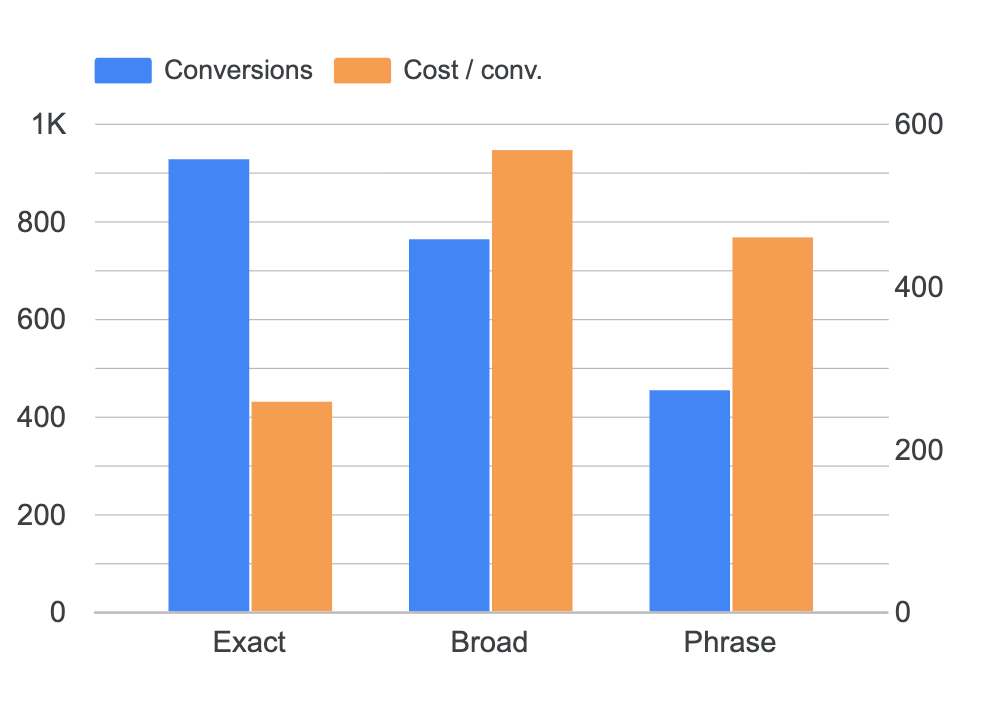
Here’s real data from my niche B2B SaaS client over the past three months: exact match keywords delivered the majority of leads at the lowest cost per lead.
Broad match received the second-highest conversions, but with a CPL 23% higher than phrase match.
That contradicts the “go all in on broad match” advice.
For niche industries, broad match without conversion data wastes budget on searches that never convert.
But it also challenges those who swear by exact and phrase match only.
Broad match can bring in quantity when you need it, but only after you have the data to control it.
Start tight and expand carefully:
- Launch with exact match on your highest intent terms.
- Add phrase match for variations (many advertisers still rely heavily on phrase and exact match because they’re cautious about broad match, and that’s fine).
- Only introduce broad match after 30+ conversions and strong negative keyword lists. Exception: if you need data quickly and have budget to spend on the learning curve, you can test broad match earlier, but watch it closely.
Mining search terms is critical
With low search volume, Google often won’t reveal which specific search terms triggered your ads, even though you’re getting clicks and conversions.
You’ll see performance metrics in your campaigns, but the search terms report won’t show you the actual queries because not enough people searched for them (Google hides this for privacy).
When search terms do show up in your reports, pay close attention.
Those represent the queries with enough volume for Google to reveal, and each one is meaningful for understanding your market.

What you’re looking for in the search terms that do appear:
- Qualified searches that got clicks but didn’t convert. (Test bid adjustments or landing page changes.)
- Irrelevant searches burning budget. (Add as negatives immediately.)
- Keyword variations you hadn’t considered. (Expand exact match coverage.)
- Searches that are too early funnel. (Lower bids or pause.)
If your brand terminology is distinct, you can be more aggressive with broad match because it naturally filters traffic.
If you’re competing for polluted keywords, build extensive negative keyword lists before broad match becomes viable.
Dig deeper: Google Ads search terms report: 5 tips for better results
Ad copy that converts niche traffic
With limited traffic, every click matters. Poor conversion rates can’t be masked with volume.
Speak the exact language your market uses
If they call it “ISO 13485 compliant quality management systems,” don’t simplify it to “quality software.”
You’ll get wrong clicks from people who don’t know what ISO 13485 means.
Pin your core differentiator in headline position 1
Let Google test supporting messages in positions 2 and 3.
Yes, pinning limits reach and can increase CPCs.
However, for niche markets, message precision matters more than slight differences in CPC.
Test dynamic keyword insertion cautiously
In high-volume markets, DKI helps scale relevance.
In niche markets with ultra-specific keywords, DKI can make ad copy too technical or too generic.
Test it, but don’t assume it helps.
Dig deeper: How to assemble captivating Google Ads copy
Use all 15 headline slots and 4 description slots
Fill everything. Google will find combinations that work.
In low-volume accounts where one good ad runs for months, you want maximum testing potential.
Design landing pages around how quickly prospects need to self-qualify
If you own your category, add technical specs, compliance certifications, and detailed case studies to speed up evaluation.
If you’re competing in crowded spaces, differentiate immediately. Prospects probably just clicked a competitor’s ad.
Your landing page has 5 seconds to clarify why you’re different.
Conversion tracking for long sales cycles
Standard 30-day attribution windows don’t capture reality for niche purchases.
Someone researching your solution might take 6 to 12 months from first click to purchase.
Extend conversion windows to match your actual sales cycle.
Google Ads allows up to 90-day click-through attribution. For longer cycles, offline conversion imports let you attribute revenue indefinitely.
Set up different conversion actions for each funnel stage.
If 30% of demo requests close at $15,000, assign demo requests a conversion value of $4,500. Smart Bidding optimizes for real business outcomes, not just form fills.
Use data-driven attribution to see how Demand Gen and Display campaigns contribute even when they don’t get last click credit.
Budget strategy for limited spend
Most niche industries work with $2,000 to $10,000 per month. Every dollar matters.
If you have brand awareness, protect it first.
Even a small branded campaign at $200/month matters when competitors can steal those clicks.
But if nobody knows your brand yet, skip this and focus budget on top-of-funnel awareness through Demand Gen instead.
Put the majority of remaining budget toward your high-intent campaigns – Search with exact match keywords and Performance Max with tight audience signals.
When Google says campaigns are “limited by budget,” don’t immediately increase spend.
For niche markets, that often means you’ve captured most available high-intent traffic. Adding budget pushes you down the intent curve into lower-quality clicks.
The better move? Improve quality score to reduce CPCs, add negative keywords, and tighten geographic targeting.
For nationwide targeting, most niche industries have geographic pockets of higher demand.
Run campaigns for 30 days, review performance by state or metro, then reallocate budget to best-performing regions.
Dig deeper: How Google Ads paces, caps, and recalculates spend when budgets change
Competitive analysis
In niche industries, you know your three to five main competitors personally. Use that strategically.
Auction Insights reports show where you’re directly competing.
If you’re losing impression share to a specific competitor in certain geographies or times, adjust bids.
But in very small markets, bidding wars just increase costs for everyone.
Sometimes, let a competitor win certain positions while you dominate others at lower CPCs.
Don’t blindly bid on competitor terms. In small markets, this usually just raises industry costs.
The exception is when a competitor doesn’t protect their brand terms. In those cases, you can capture consideration-stage traffic at reasonable CPCs.
Monitor competitor ad copy and landing pages quarterly. Major messaging shifts signal market changes worth understanding.
What works for each scenario
If you own your brand space
Use broad match more aggressively once you have conversion data. Your terminology naturally filters traffic.
Focus budget on capturing all branded traffic and expanding to problem-based searches.
Demand Gen works well for educating a market that doesn’t know you exist.
Landing pages can be technical and detailed because prospects who find you are serious buyers.
If you’re fighting keyword pollution
Stay tight on exact match until 50+ conversions.
Build extensive negative keyword lists shared across campaigns.
Use in-market audiences in observation mode to find specific subsets within broader categories.
Demand Gen needs precise audience targeting because you can’t blast generic industry interests.
Landing pages must differentiate immediately. Assume every visitor just came from a competitor.
How niche advertisers win in 2026
The niche advertisers who win in 2026 aren’t those with the biggest budgets.
They understand that:
- Signal quality beats search volume.
- Multi-surface visibility beats search-only strategies.
- Precise targeting matters more than broad reach.
Google’s automation works when it’s fed the right data.
For niche industries, success comes from knowing which automation to use early, which to delay until enough signals exist, and which standard tactics simply don’t apply.