Wikipedia is a fascinating experiment. It’s a community-built encyclopedia that’s always in motion. It runs on volunteer energy and openly shared infrastructure, and it’s closer to an open-source project in how it’s built than a traditional encyclopedia book. Anyone can write, edit, and debate what belongs on a page.
And that’s the twist. The “truth” on Wikipedia isn’t handed down by a single editor or community member. It’s negotiated in public, guided by community standards, citations, and a whole lot of conversation. Contributors don’t so much control a subject’s story as they continually test it. They’re constantly asking questions: What can we verify? What deserves weight? What’s missing?
When you read a Wikipedia article, you’re seeing a current snapshot of a living, evolving community decision.
This whole experiment has scale, too. As of February 6, 2026, the English Wikipedia had 7.13 million articles, and the project spanned more than 340 languages.
If you’re thinking about creating a Wikipedia page for your company, it helps to know what you’re signing up for. Wikipedia isn’t a marketing channel, and it isn’t designed for companies to shape their narrative.
It’s designed to summarize what independent, reliable sources have already said about a company, so not every organization qualifies for a stand-alone article. Wikipedia cautions that only a small percentage of organizations meet the requirements for an article in the first place.
The easiest way to orient yourself with the platform is to keep Wikipedia’s “five pillars” top of mind. Wikipedia is, first and foremost, an encyclopedia. It aims for a neutral point of view, the content is free for anyone to use and edit, editors are expected to be civil, and there are no hard-and-fast rules. It’s just policies and guidelines applied with unbiased judgment.
If your company is genuinely notable by Wikipedia’s standards and you’re willing to play by its guidelines, there’s a real visibility upside in a solid, well-sourced page that holds up over time.
Key Takeaways
- Wikipedia isn’t for marketing. If a Wikipedia page reads like company positioning, a feature brochure, or a pricing page, it’ll get rejected, reverted, or flagged. Even if other company pages “get away with it,” you need to focus on creating a deeply researched, informative draft to give strong notability in Wikipedia’s eyes.
- Notability = independent coverage. You need multiple strong secondary sources (real reporting with editorial standards). Press releases, paid placements, niche trade mentions, and contributor “interviews” don’t hold up.
- Sources drive the outline (and the page). Build your outline from what your credible secondary sources already cover. Possible sections could include a lead, history, high-level operations, leadership, or controversies, if documented. Each company’s outline may look different depending on what information can be strongly sourced. If you can’t source a section cleanly, it doesn’t belong.
- Use Wikipedia’s Articles for Creation (AfC) process to avoid conflict of interest (COI) roadblocks. If you’re connected to a company or paid to write a Wikipedia page for them, you must disclose it and lean on the AfC process instead of directly pushing a company page live.
- Getting published isn’t the finish line. Volunteers continuously review pages. Expect ongoing edits, scrutiny, and occasional challenges, so monitor a live page and keep it updated with strong, independent citations.
What Are the Benefits of Creating a Wikipedia Page?
The most significant benefit of Wikipedia is its sheer size and reach. It is one of the most visited websites in the world, averaging more than 1.1 billion unique visitors per month.
In addition to the size of its audience, the platform offers other benefits to marketers and company owners:
- Credibility via independent validation (earned, not claimed): A live Wikipedia page signals that reliable, third-party sources have covered your organization in a meaningful way. For journalists, partners, investors, and enterprise buyers, this can reduce skepticism during research.
- Search and AI visibility (off-page, long-term): Wikipedia tends to surface prominently in search results and is commonly referenced by knowledge systems. A well-sourced page can support progress in how your company appears in search features, AI overviews (AIOs), and large language model (LLM) output, based on what independent sources say, not what a company wants to say.
- A neutral orientation page for readers: Wikipedia’s format helps readers quickly understand a company’s basics, including history, products or services, leadership, milestones, and context. The tradeoff is accessible neutrality. Anything included needs support from reliable secondary sources, and promotional language rarely lasts.
- Clarity and disambiguation: If your name overlaps with other companies, or your story includes mergers, rebrands, or multiple founders, Wikipedia can help people land on the right entity and timeline.
- A durable reference hub: A good Wikipedia page often becomes a stable directory of the strongest independent sources about you, such as press, books, and other reputable coverage, so readers can verify details without relying on your website alone.
- Consistency across the web (a quiet multiplier): Wikipedia and related knowledge sources are reused in many downstream places. When the facts are clean, cited, and consistent, it can improve how your company is represented across third-party profiles and information panels over time.
A Wikipedia page is rarely a conversion engine, and it isn’t a place to “own” your story. The value is credibility and discoverability that can compound, but benefits can vary based on the strength of independent coverage and ongoing community scrutiny.
Below, we’ll cover the 10 steps on how to create a Wikipedia page, as well as considerations to keep in mind.
1. Check to See If Your Company is a Good Fit for a Wikipedia Page
Before you think about how to create a Wikipedia page for your company, you need to answer one question:
Would Wikipedia editors consider your company “notable”?
On Wikipedia, “notability” has nothing to do with how compelling your company story is. It means there’s enough independent, reliable coverage about your company that an article can be written from what third parties have already published, without filling in gaps with interpretation, insider knowledge, or marketing claims.
This is also where a lot of brand teams get tripped up. Again, Wikipedia isn’t a marketing channel. It’s not a place to shape messaging or control a narrative. If the only story you can tell is the one you want to tell, the page will be declined during initial submission review or deleted later.
What Notability Actually Looks Like
A company is usually considered notable when it receives significant coverage in multiple reliable sources independent of the company. “Significant coverage” is the key phrase here. Editors are looking for articles that discuss your company in real depth, not quick mentions or short blurbs.
A helpful way to think about it is this: if you can’t outline a neutral article using independent secondary sources alone, you probably don’t have enough notability yet.
Editors typically want coverage that checks these boxes:
- Independent: Truly third-party reporting. Not press releases, paid placements, sponsored posts, advertorials, partner blogs, or content your PR team arranged. If a piece exists because the company made it happen, editors tend to discount it.
- Significant: More than a passing mention. A funding announcement, product launch blurb, or event listing can be real coverage and still not be enough. The strongest sources are the ones that explain context, impact, history, or controversy in detail.
- Secondary: Sources that analyze, summarize, or report on the company from the outside. Primary sources like your website, blog, press page, or social channels can support basic facts in limited cases, but they do not establish notability.
- Reliable: Publications with editorial oversight and a reputation for accuracy. Big-name outlets can help, but they are not the only option. Trade and industry publications can be excellent sources when they have real editorial standards and provide in-depth coverage, but you can rarely use them to establish notability.
- Multiple and sustained: A single great source is rarely enough on its own. Editors want to see more than one strong source, ideally across time, so the page can hold up after more people review it.
- Neutral tone: Even when a source is independent, it can still be weak if it reads like promotion. Glowing profiles, “thought leadership” posts, or contributor content that feels like marketing often carry less weight than staff-reported coverage.
One nuance that matters a lot in practice is that “lots of links” does not equal notability. Companies can appear all over the internet through routine announcements and PR-driven writeups and still fail Wikipedia’s notability test.
What matters is whether independent sources have treated the company as worthy of real, substantive coverage. This also means that magazines and trade publications can’t work as reliable coverage to establish notability. Many industry leaders also run trade organizations, creating a conflict of interest (COI, in Wikipedia’s terms) if their trade publication were to cover their own company or the companies of friends or contributors.
If your company does not meet this bar yet, that’s not a judgment on it. It just means a Wikipedia article is likely premature, and the better move is to wait until there is enough independent coverage to support a neutral, well-sourced page.
A Note on Conflict of Interest (COI)
If you’re writing about your own company (or you’re paid to write for a company), Wikipedia considers that a conflict of interest (COI). That doesn’t automatically ban you from participating, but it does change how you should approach it.
When creating a new page, submit it to Articles for Creation (AfC) to ensure community editors review it properly.
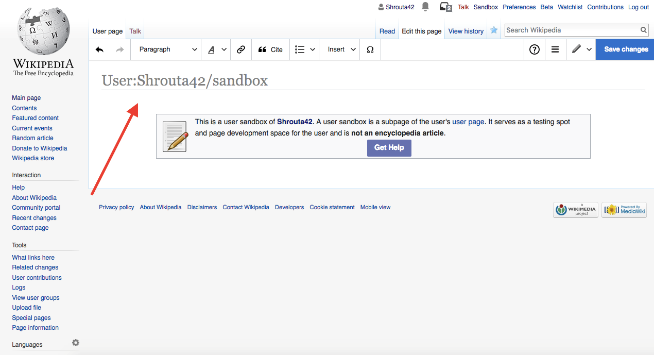
When editing an existing page, you want to create your edits in a Sandbox draft (the Sandbox is a personal workspace where you can safely draft and refine changes to an article before submitting them for public review). Then, you submit that Sandbox draft onto the live Wikipedia page’s Talk page, along with a comment that asks community members to review and collaborate on the edits you suggested. Once a community consensus is reached, you can push those edits or additions live.
Source: https://courses.shroutdocs.org/tutorials/editing-your-wikipedia-sandbox/
It’s also a good idea to disclose your COI connection. Your disclosure should be one of the following:
- A statement on your User page.
- A statement on the Talk page accompanying any paid contributions.
- A statement in the edit summary accompanying any paid contributions.
Avoid directly creating or heavily editing an article and stick to Wikipedia’s COI process to request edits for independent editors to review.
Again, this is about expectations. If your team is hoping to just write a draft and hit “publish,” like you do with a blog, you’re going to have a bad time. But if you do have strong, independent coverage from credible outlets, you’ve got a real shot and can move to the next step.
2. Create a Wikipedia Account
Creating an account is a practical next step if you plan to contribute to Wikipedia. While you don’t need an account to read Wikipedia (or even to edit some pages), registering gives you features that make collaboration and transparency easier.
With an account, you can:
- Create a User page (a simple profile and a place to draft in a Sandbox).
- Use your Talk page to communicate with other editors.
- Build an edit history tied to your username (helpful for credibility and continuity).
- Work through article creation more smoothly, including drafting and submitting via AfC.
If you add images to your User page, make sure they’re properly licensed. Wikipedia generally accepts only freely licensed uploads.
To register, use Wikipedia’s account creation form.
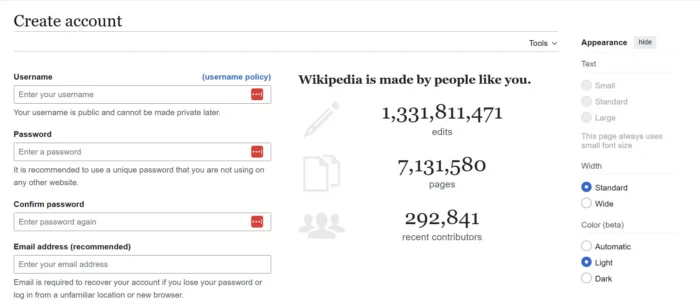
After that, you’re set up to start editing, drafting, and participating in the community.
3. Contribute to Existing Pages
Quick reminder from earlier: If you’re connected to the company, you’re dealing with a COI. That’s why Wikipedia prefers that company pages undergo independent review before publication.
As a newbie, a good way to get comfortable on Wikipedia is to start by editing existing articles that have nothing to do with your organization. When you spend time improving clarity, tightening wording, and backing up facts with solid sources, you learn how Wikipedia works, and you build a history of helpful contributions.
As you do that, your account may become autoconfirmed. That usually happens automatically after your account has been around for more than four days and you’ve made at least 10 edits to Wikipedia pages that need them. Autoconfirmed status primarily grants a few basic permissions, such as creating pages and editing some semi-protected articles.
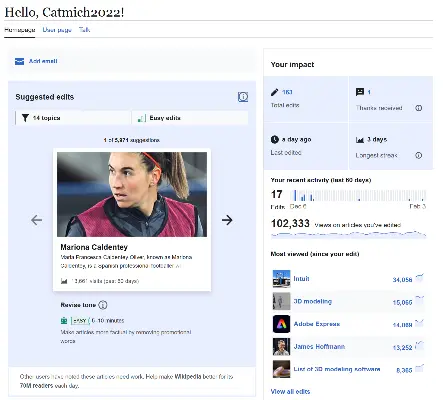
Here’s the key point, though: “Autoconfirmed” does not change your COI situation. Even if you can technically publish a page directly, a company-related article should still be written as a draft and submitted through AfC. This is the step that gets you the independent review Wikipedia expects, and it’s the safest, most appropriate route for a company page.
4. Conduct Research and Gather Sources
Before you write a single line of your Wikipedia draft, do the homework. Wikipedia doesn’t prioritize non-source-backed storytelling. The platform only cares about verifiability, meaning every meaningful claim must be backed by a reliable secondary source that an editor can check. Your company story could play well on Wikipedia, as long as there’s enough reliable evidence to back it up.
This is where most company pages fall apart. Not because the company isn’t real, but because the sources are thin, biased, or too “inside baseball.”
Why sources matter so much on Wikipedia
Wikipedia runs on two big rules:
- No original research: You can’t “introduce” new facts, even if they’re true, without proper citation. Which leads to the next point…
- Cite everything that matters: If it’s notable, controversial, or specific (revenue, awards, history, key dates, acquisitions), you need a secondary source to back it up.
Primary vs. secondary vs. tertiary sources (and how Wikipedia treats them)
Wikipedia breaks sources down into three categories: primary, secondary, and tertiary. Here is a look at each and how they play into the strength of your Wiki page:
- Primary sources (you): Your website, press releases, investor decks, published reports, filings (e.g., Securities Exchange Commission (SEC), etc.).
- Upside: Can work for basic, factual details (launch dates, historical milestones, etc.).
- Downside: Biased by default. Editors won’t accept these for “notability” or big claims like “industry leader.”
- Secondary sources (best for Wikipedia): Independent journalism, books, academic analysis, reputable profiles.
- Upside: Shows the world noticed you. This is the backbone of the strongest pages.
- Downside: Harder to earn, and fluff pieces don’t carry much weight.
- Tertiary sources: Encyclopedias, databases, reputable directories.
- Upside: Useful for quick confirmation and context.
- Downside: Often too shallow to prove notability on their own.
Overall, secondary sources are the most important to your success. By their nature, these sources are pivotal in helping you summarize what experts think about a company or topic in Wikipedia’s voice. Relying heavily on these gives you a really strong case for notability in Wikipedia’s eyes.
What Makes a Good Wikipedia Source?
Good Wikipedia sources cover topics while maintaining editorial standards. Think major publications, local newspapers of record, respected business outlets, and independent industry analysis. If you’re short on that kind of coverage, that’s usually a PR problem, not a Wikipedia problem. Strengthening your digital PR (DPR) efforts can help you earn credible mentions that hold up under editor scrutiny.
But DPR for a Wikipedia use case must be handled carefully. What tends to work is focusing on independent coverage first. This looks like pitching credible story angles to journalists and outlets that genuinely cover your industry, and accepting that they may say no, or cover the story in a way you can’t control.
When an outlet does publish real, editorial reporting, that’s the kind of secondary source Wikipedia editors are more likely to accept.
Reliable Sources at a Glance
After seeing what Wiki editors consider reliable sources, you might be wondering where you even find sources that hit all their criteria. It helps to look at real-world use cases of which sources are best for your company. Here are some of the types of sites you can choose from.
For company pages, the sources that matter most are the ones that provide significant, independent coverage; the kind that demonstrates notability and gives editors something substantial to cite.
- Major national/international newsrooms (strongest for notability + facts): Reuters, AP, BBC, Financial Times, The Wall Street Journal, Bloomberg, The New York Times, The Washington Post, NPR (news reporting over opinion).
- Reputable business and investigative reporting: Deep dives and investigations from established outlets (e.g., ProPublica) can be highly valuable, especially for controversies, legal issues, and accountability reporting.
- High-quality trade press with editorial oversight (context-dependent): Useful for industry coverage when it’s independent and more than a product announcement or reposted PR. You cannot use trade press as a primary indicator of notability, though.
- Books from reputable publishers: Especially helpful for founders, company history, and industry impact when written by independent authors and published by established presses.
- Government and major non-governmental organization (NGO) reports (within remit): Strong for regulatory actions, enforcement, public contracts, or formal assessments (but not a substitute for independent secondary coverage).
- Medical/health claims (only when relevant): For biomedical statements, prioritize high-quality secondary sources like systematic reviews and authoritative guidelines (MEDRS standard), not individual studies or marketing claims.
Check out Wikipedia’s Perennial Sources list to see which sources have a good community track record because they all meet a high level of fact-checking and editorial standards. But remember, the sources featured in this list are still contextual; it’s not a whitelist.
Non-reliable Sources
To paint a clearer picture, here are some of the sources you should avoid:
- Self-published/user-generated content (UGC): Personal blogs, Substack/Medium posts, self-hosted sites, most social media.
- Press releases/advertorial: Company press rooms, PR wires; these are fine to state that an announcement occurred, not to establish third-party facts or notability.
- Sensational/tabloid sources: Outlets known for gossip/sensationalism; poor for verifying facts.
- Anonymous forums and crowdsourced threads: Message boards, comment sections, most Reddit/4chan/Discord posts.
Wikipedia views these types of sources as weaker because they aren’t research-backed, trustworthy, or credible. The common thread is that they undergo minimal editorial oversight (if any) or, in Reddit’s case, most of the content is UGC and self-published.
5. Research Your Competition
Like many things when it comes to Wikipedia, researching your competitors is fine if you do it the right way. As you start your research, view your competitors’ pages through the lens of what Wikipedia editors ultimately want.
The challenge here is that Wikipedia isn’t perfectly consistent. Some company pages are old, lightly monitored, or haven’t been updated to match today’s standards.
When someone says, “But other pages include feature lists and product tier breakdowns,” that doesn’t really matter. Editors don’t treat “other pages do it” as a justification. They judge your page on whether it reads like an encyclopedia entry and whether it’s backed by independent, reliable sources.
General Competitor Research Rules
Use competing Wiki pages to answer questions like:
- What’s the typical structure for a company page in your category? Take note of the typical section titles. (We’ll dive into this next.)
- What kind of claims survive without getting reverted? (Neutral, sourced, non-promotional.)
- What sources are doing the heavy lifting on pages that stay live?
A “Wiki-safe” Research Method
Pick 3–5 competitors with live pages, then audit them like an editor would:
- Scan the citations first. Are they mostly independent, secondary news coverage, press releases/company sites, or paid placements?
- Check the tone. If it reads like a promotional brochure (feature-by-feature, pricing tiers, “best-in-class”), that’s a red flag, even if it hasn’t been removed yet.
- Look at the page history and Talk page. Lots of reverts, banners, or sourcing disputes usually mean the page is shaky.
- Note what’s missing. If competitors avoid detailed feature lists, that’s usually a sign that those details don’t belong on Wikipedia.
6. Create an Outline
Once you’ve got your sources, your outline has a starting point. The hard part is deciding what belongs.
On Wikipedia, an outline is not “everything you want to say.” It’s you making careful decisions about what independent, reliable sources have actually covered, what they have not covered, and what deserves space without turning the page into a brochure. That takes judgment, and it often takes multiple passes.
The mindset you want is simple: Wikipedia pages are built around what reliable secondary sources already said about the subject. Your outline is how you organize those sourced facts into a structure that editors recognize and are willing to review.
Start with the standard Wikipedia “shape”
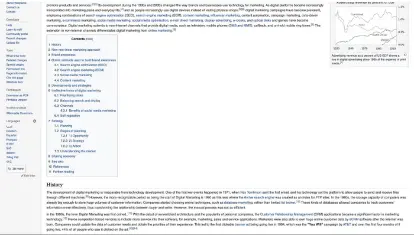
Most company pages follow a formulaic layout:
- Infobox (quick facts): Founded, founders, headquarters, industry, key people, website, and similar basics. Only include items you can verify.
- Lead (opening summary): 2–4 neutral sentences explaining what the company is, where it’s based, what it does at a high level, and why it’s notable. This is not a tagline.
- History: Founding and major milestones, expansions, acquisitions, funding or IPO, only if independent sources cover them, and major pivots. Focus on events that third parties actually reported.
- Operations/Business (optional, and only if sourced): What the company does at a high level and what markets it serves. Avoid feature-by-feature descriptions and pricing tiers.
- Leadership/Ownership (optional): Only if reliable sources discuss executives, ownership changes, or governance in a meaningful way.
- Reception/Controversies (only if they exist in sources): Reviews, notable criticism, legal issues, regulatory actions, all written neutrally and backed by sources.
- See also / References / External links: References do the heavy lifting; external links are usually minimal (often just the official site).
Using Your Sources to Build the Outline
Start with your strongest independent secondary sources and work outward. As you read through them, you’re identifying what the coverage actually emphasizes.
As you review sources, pull out:
- Events they cover (those become history sections)
- Claims they support (those become lead and operations sections)
- Any recurring themes across sources (those become section headings)
Each major section in your outline should be supported by multiple secondary sources, not a single mention. Also, keep an eye on the length as you draft. Wikipedia discourages overly long articles unless the amount of independent coverage truly warrants it. If a section or topic isn’t discussed in depth by reliable secondary sources, it usually doesn’t belong at length in the article.
If you focus on covering the topic from an encyclopedic angle and you leave out anything that feels like marketing, you will give your draft a much better chance of surviving review.
7. Write a Draft of Your Wikipedia Page
Take your time as you write a draft of your Wikipedia page from your outline. You want your content to be source-backed, thorough, thoughtful, and genuinely useful, giving readers the information they came for.
At this stage, it’s best to write your draft in a Wikipedia Sandbox. As mentioned earlier, this is a personal workspace where you can draft safely, revise freely, and share the link with others for informal feedback without accidentally publishing anything live.
While a Wikipedia page can support your broader visibility, the platform’s purpose is encyclopedic and impartial. Anything that reads as emotional, salesy, or promotional is likely to be flagged and can lead to rejection later in the process.
Aim for short, direct sentences that stick to verifiable facts. And those facts need strong secondary sources. For example, if you write, “Spot ran to the big oak tree yesterday,” that claim would need a source. Not just any source, but a credible, independent secondary source that Wikipedia considers reliable.
It’s also critical to remember you’re writing on behalf of Wikipedia. Aka, you’re writing in Wikipedia’s unbiased, impartial, and neutral voice.
Here are some examples to show what this looks like in practice:
Example 1: Product Description
- Promotional: “XYZ Software is a revolutionary, industry-leading platform that empowers businesses to achieve unprecedented productivity gains. With its cutting-edge AI technology and intuitive interface, XYZ transforms the way teams collaborate, delivering exceptional results that exceed expectations.“
- Neutral: “XYZ Software is a project management platform that combines task tracking, team messaging, and file sharing. The software is used by businesses to coordinate work across departments.[1][2]“
Example 2: Company History
- Promotional: “Founded by visionary entrepreneur Jane Smith, the company quickly rose to prominence as a game-changer in the industry. Through relentless innovation and unwavering commitment to excellence, it has become the trusted choice for Fortune 500 companies worldwide.“
- Neutral: “The company was founded in 2015 by Jane Smith in Seattle.[3] It launched its enterprise tier in 2019 and rebranded from “TaskFlow” to its current name in 2021.[4][5]“
Wikipedia also defines “promotional” language differently. It’s more than simply using words like “revolutionary” or “legendary.” Factually correct statements can still be considered “promotional” in a Wikipedia editor’s eyes if they meet certain structure and emphasis criteria:
- Long, comprehensive feature inventories.
- Plan/tier breakdowns that resemble packaging (“Free vs. Premium vs. Enterprise”).
- Performance claims that read like sales positioning.
- Product-benefit phrasing stacked repeatedly (“includes tools for…,” “enables…,” “helps…”).
- Details that feel like purchase guidance (pricing, quotas, storage limits, admin entitlements).
Let’s talk about specs and features for a second. If your company is well-known for a particular product or service, it can be tempting to include a specification or feature list on your Wikipedia page. Unfortunately, that can cause problems with Wikipedia for several reasons.
Here’s why:
- Wikipedia isn’t a manual or catalog: Wikipedia tries to avoid becoming vendor documentation. Specs and feature matrices belong on the company site, in the documentation center, in release notes, or on third-party comparison sites, not in an encyclopedia.
- Specs change constantly: Feature sets, tiers, storage limits, and admin/security capabilities change frequently. Wikipedia content must remain stable and verifiable over time. Highly granular spec content becomes outdated quickly and attracts disputes.
- It’s hard to verify neutrally: If the only source for a feature or tier is the vendor’s own site or press release, Wikipedia considers that primary sourcing; useful for limited factual verification, but not ideal for describing capabilities in detail or making value claims.
- “Undue weight” and imbalance: Even accurate feature lists can give a product more prominence than independent sources do. Wikipedia tries to reflect external coverage: if reliable third parties don’t treat a feature as notable, Wikipedia typically won’t either.
What a Company’s Wikipedia Draft Should Look Like
Much like sourcing, it’s hard to imagine what an acceptable draft should look like, given all of Wikipedia’s guidelines. Here’s a brief rundown of what a solid draft should look like when you’re done:
- A clear, high-level description of what a company is (one paragraph, not a feature catalog).
- A history/timeline of major milestones (launches, renames, major releases) backed by independent sources.
- Widely covered integrations/partnerships only when reported by reliable third parties.
- A short, selective “features” summary only for capabilities that independent sources treat as notable and cover in-depth.
8. Upload Your Page into the Article Wizard
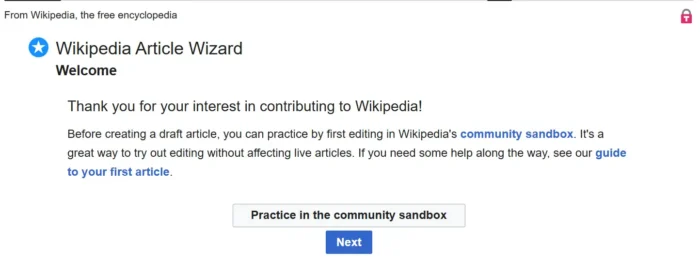
Once your Sandbox draft is in good shape, move over to the Wikipedia Article Wizard. The Wizard is the guided tool that helps you move what you wrote from your Sandbox into Wikipedia’s Draft space, which is where new articles are typically prepared before they go live.
For company-related pages, the key takeaway is that the Wizard is the structured path to getting your draft into the right place so it can be submitted for independent review.
9. Submit Your Article for Review
Now that your draft is in Draft space, you’re ready for the step that triggers formal evaluation by the community. Submit your draft through Articles for Creation by clicking “Submit for review.” This is when your draft enters the AfC queue, and a volunteer reviewer takes a look.
The timeline can range from a few weeks to a few months, depending on backlog and whether the reviewer requests changes. It’s also common for drafts to be declined at first, with feedback you’ll need to address before approval.
At NPD, we’ve found that sticking with AfC is the best practice for companies looking to go live. Even though autoconfirmed accounts may have the technical ability to publish directly, that path often creates more friction for company-related topics. AfC sets expectations for independent review from the start and helps reduce avoidable issues related to COI and other Wikipedia guidelines.
10. Continue Making Improvements
Once your page is accepted, the work is not really over.
Wikipedia is editable by anyone, so changes can happen at any time. Some edits will be helpful, some will be mistaken, and some may reflect a negative point of view. The best approach is to keep an eye on the page so you can understand what is changing and respond appropriately, usually by suggesting improvements on the Talk page or updating the article with strong, independent sourcing.
As the page gets more visibility and gains traction on Google and LLMs, focus on accuracy and neutrality rather than “updating marketing messaging.” Wikipedia is not the place for routine product updates, but it is the right place to reflect significant, well-covered developments when reliable third-party sources have written about them.
You should also plan for the possibility that your draft will be declined. That is common, especially for company-related topics. If it happens, do not get discouraged. Read the reviewer’s comments carefully, make the requested changes, and resubmit when you have addressed the specific issues that kept the draft from being accepted.
FAQs
Should I build a Wikipedia page for my company?
A Wikipedia page can be a meaningful credibility asset, but it isn’t a fit for every company. The deciding factor is whether there’s enough independent, reliable secondary coverage to support a neutral article. If you can’t outline the page using third-party sources alone, it’s usually too early.
If your company does qualify, the value tends to be indirect: stronger brand legitimacy, clearer “who you are” context in search results, and more consistent entity information across the web. It’s less about immediate conversions and more about long-term visibility and trust signals that can compound.
Yes. Creating, publishing, and maintaining a company page is challenging because Wikipedia is community-reviewed and built around strict expectations: neutral tone, verifiable claims, and high-quality sourcing. You also have to plan for ongoing edits and scrutiny after the page goes live.
The opportunity is achievable if you have strong independent coverage and treat the process as encyclopedic documentation rather than company messaging.
How do I know if my Wikipedia page will be published?
There’s no guaranteed way to know. Even well-prepared drafts can be declined, revised, and resubmitted, especially for company topics.
Your best indicators are practical: you have multiple independent sources with significant coverage, your draft reads neutrally (not like marketing), and you submit through the Articles for Creation (AfC) process so reviewers can evaluate it in draft space.
How long will my Wikipedia article be under review before publication?
Review time varies widely. Some drafts are reviewed quickly, but it’s also common for company-related submissions to take weeks (or longer) depending on backlog and how many revisions are needed. A decline doesn’t mean “never”; it usually means “not yet” or “needs stronger sourcing and a more neutral rewrite.”
{
“@context”: “https://schema.org”,
“@type”: “FAQPage”,
“mainEntity”: [
{
“@type”: “Question”,
“name”: “Should I build a Wikipedia page for my company?”,
“acceptedAnswer”: {
“@type”: “Answer”,
“text”: “
A Wikipedia page can be a meaningful credibility asset, but it isn’t a fit for every company. The deciding factor is whether there’s enough independent, reliable secondary coverage to support a neutral article. If you can’t outline the page using third-party sources alone, it’s usually too early.
If your company does qualify, the value tends to be indirect: stronger brand legitimacy, clearer “who you are” context in search results, and more consistent entity information across the web. It’s less about immediate conversions and more about long-term visibility and trust signals that can compound.
”
}
}
, {
“@type”: “Question”,
“name”: “”,
“acceptedAnswer”: {
“@type”: “Answer”,
“text”: “
Yes. Creating, publishing, and maintaining a company page is challenging because Wikipedia is community-reviewed and built around strict expectations: neutral tone, verifiable claims, and high-quality sourcing. You also have to plan for ongoing edits and scrutiny after the page goes live.
The opportunity is achievable if you have strong independent coverage and treat the process as encyclopedic documentation rather than company messaging.
”
}
}
, {
“@type”: “Question”,
“name”: “How do I know if my Wikipedia page will be published?”,
“acceptedAnswer”: {
“@type”: “Answer”,
“text”: “
There’s no guaranteed way to know. Even well-prepared drafts can be declined, revised, and resubmitted, especially for company topics.
Your best indicators are practical: you have multiple independent sources with significant coverage, your draft reads neutrally (not like marketing), and you submit through the Articles for Creation (AfC) process so reviewers can evaluate it in draft space.
”
}
}
, {
“@type”: “Question”,
“name”: “How long will my Wikipedia article be under review before publication?”,
“acceptedAnswer”: {
“@type”: “Answer”,
“text”: “
Review time varies widely. Some drafts are reviewed quickly, but it’s also common for company-related submissions to take weeks (or longer) depending on backlog and how many revisions are needed. A decline doesn’t mean “never”; it usually means “not yet” or “needs stronger sourcing and a more neutral rewrite.”
”
}
}
]
}
Conclusion
If you’re looking to increase traffic, improve your search everywhere visibility, or build credibility, Wikipedia can be part of the equation. But it’s not a marketing channel, and it isn’t built for companies to shape their narratives. It’s a community-edited encyclopedia that summarizes what independent, reliable sources have already said about you.
Where Wikipedia can help is in discovery and trust signals. A stable, well-sourced page often shows up prominently for company and topic queries, and it can reinforce consistent “entity facts” that search engines and other knowledge systems use to understand companies.
That’s also why Wikipedia often pairs well with entity SEO. When key details about your organization are documented consistently across reputable sources, your company is easier to interpret and surface accurately across platforms, including some LLM-style experiences. Results may vary based on implementation, the strength of independent coverage, and ongoing community review.
As you evaluate whether your company is a good fit for a Wikipedia page, keep in mind that the process is complicated, and it won’t be fully in your control. What matters most is having enough independent, reliable secondary coverage to justify a stand-alone article and being willing to follow Wikipedia’s COI expectations.