
Google Daily Hub: Anatomy of an overambitious system shaping the future of search
 By DynamicSEO

Google’s Daily Hub is more complex than it first appears.
It’s part of the broader acceleration toward hyperpersonalization we’ve been seeing in recent months – Preferred Sources, Profile Pages with followable elements in Discover, Brand Profiles in Merchant Center – all converging toward a single goal: anticipating your needs before you even formulate a query.
Daily Hub is the concrete expression of the “News Digest and Daily Brief” agent identified during our investigations this summer into Google’s 90 AI projects via the AI Mode debug menu.
The internal architecture of the system, which Damien Andell managed to decrypt and share with me in advance, reveals a level of technical complexity that also explains why Google temporarily suspended the feature in September 2025, just a month after its launch on the Pixel 10.
The three-tier architecture of Daily Hub
To understand Daily Hub, imagine a conductor (Gemini) who must coordinate three sections of a symphony orchestra, each playing a different score but having to harmonize in real time.
This is exactly what Google is trying to do with this system.
First tier: The ‘memory and embeddings’ layer
Daily Hub relies on two fundamental types of documents that constitute its memory:
MemoryDocument represents the complete content unit. Each document contains:
- Structured textual content (title, summary, rawText divided into segments).
- A list of entity identifiers (entityIds) extracted from the Knowledge Graph.
- Two types of embeddings: contentEmbeddings for the entire document and chunkEmbeddings for each segment.
- Technical metadata (sourceDataIds, memoryTimeMs, servingState).
- Binary data (memoryContentBytes, memoryInfoBytes) for optimized storage.
MemoryEntityDocument is lighter and represents each extracted entity:
- Entity characteristics (entityType, entityText, entityDescription, entityTag).
- Link to parent document via parentMemoryId and memoryQualifiedId.
- A single embedding (contentEmbeddings) without chunk division.
- A specific timestamp (entityTimeMs).
Concretely, if Daily Hub processes an article about “Lionel Messi joins Inter Miami”, the system will create:
- A MemoryDocument containing the complete article with its embeddings.
- Several MemoryEntityDocument: one for “Lionel Messi” (type: Person), one for “Inter Miami CF” (type: Organization), one for “soccer” (type: Sport), etc.
This dual structure allows the system to navigate either by content (via documents) or by entity (for thematic recommendations).
Second tier: The personalization triumvirate
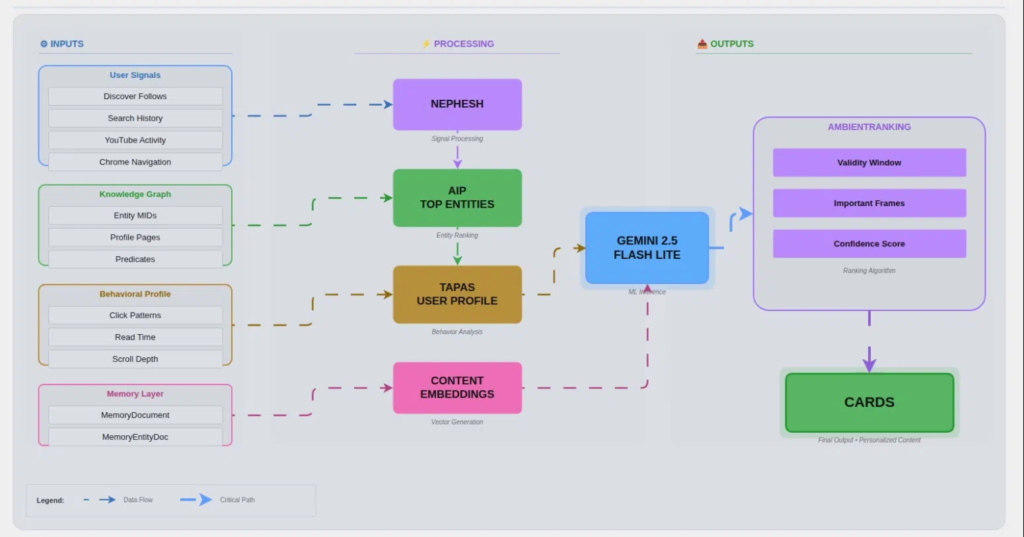
Andell discovered that three parallel systems feed Daily Hub’s personalization:
Nephesh (the universal embeddings system)
This is Google’s universal embeddings system that Andell had already documented in his analyses of Discover (to preserve its anonymity, the name of this model has been changed in this article).
In the context of Daily Hub, Nephesh:
- Stores interests in ContentInterest.db via SQLite.
- Associates each subject with a numerical score (string parsed to double).
- Uses deduplication keys (dedupe_key_nephesh_content_interest) to avoid duplicates.
Example of Nephesh data structure:
{
  "football": "0.82",
  "cooking": "0.65",
  "AI": "0.91"
}
The code reveals the parsing mechanism:
CustomNepheshData.getScore() → String
parseDouble() → Double
→ Injection into interest builder
AIP_TOP_ENTITIES
This system manages the user’s “top entities” from the Knowledge Graph:
- Daily updates based on interactions.
- Fed via “Follow” buttons in Discover as part of the Google Profile Pages project.
- List ordered by decreasing importance.
When you click “Follow” on a publisher in Discover, their KG entity (with its MID like /g/11h7hztqbj) is added to your profile via the profile.google.com URL.
These Google Profile Pages allow you to see the publisher’s social history, their latest articles, and create a persistent link between you and that entity.
The next day, this entity appears in the prompts sent to Gemini to personalize the Daily Hub.
However, this list is not built solely from clicks on the “Follow” button, but from a mix of explicit signals (what you choose to follow) and implicit signals (what Google infers from your browsing and the content you consume).
In other words, the “Follow” button is just the visible part of the iceberg: it provides a strong explicit signal, but AIP_TOP_ENTITIES ultimately orchestrates a broader ranking that also aggregates these implicit signals.
TAPAS_USER_PROFILE
The semantic profile system that aggregates:
- Behavioral features (clicks, reading time, scroll).
- Cross-product browsing history.
- Implicit preferences deduced from usage patterns.
Third tier: ‘ambient’ orchestration
This is where coordination happens. The AmbientRanking system orchestrates card display via structured metadata:
AmbientRankingMetaDataDocument contains for each card:
- Global validity window: startTimeMillis → endTimeMillis.
- Important intervals: importantTimeFrames (list of priority slots).
- Confidence score: confidence (double between 0 and 1).
- Actions: tapAction, dismissAction, seenAction.
- Metadata: creationTimestamp, documentTtlMillis, notificationDedupeId.
Let’s take a concrete example:
Card “Lakers vs Celtics Score”
- Global window: 6:00 PM → 11:00 PM
- Important intervals: 8:00 PM → 10:00 PM (game in progress)
- Confidence: 0.92
- Behavior:
- At 9:00 PM: Maximum score (in window + important interval + high confidence).
- At 10:00 AM: Card invisible (outside window).
- At 7:00 PM: Average score (in window but outside important interval).
The system supports different types of Ambient cards:
- SportsScoreAmbientDataDocument: Real-time sports scores.
- EventAmbientDataDocument: Calendar events.
- InvestmentRecapAmbientDataDocument: Financial market summaries (recall that in our summer experiments, we found JUNE FinanceDailyRecapImplicitAppbarLaunch::LaunchLAUNCH).
- CommuteAmbientDataDocument: Commute information.
- TypedThingAmbientDataDocument: Generic typed content.
Gemini prompts: The system’s thought process revealed
Andell managed to capture the exact prompts sent to Gemini. This is a goldmine for understanding the system’s logic.
Prompt ‘news topics’: News over 7 days
The system uses gemini-2.5-flash-lite with this detailed structured prompt:
- “You’re an expert at understanding a person’s interests and identifying what news topics they would be interested in following. You are also an expert at scanning the latest news announcements and articles published over the last seven days using Google Search. You are then able to quickly identify the most interesting and important topics in the news over the last week that a person would be interested in knowing about, and you can summarize the key takeaways for them in a way that’s easy to understand.”
The numerous imposed constraints:
“Guidelines for finding news topics:
1. The current date is 2025-08-31. The news and articles you focus on should all be published in the last seven days.
2. The news topics you summarize should be interesting and important for someone that has the following top interests: [LIST OF 100+ INTERESTS]
3. Each news topic should be related to a different interest. No interests should be repeated in the news topics list.
4. Do not include any news themes related to Banking or Shopping.
5. News topics should be related to these 7 categories: Global News, Business News, Technology News, Popular Culture News, Sports News, Science News.”
Explicit thematic restrictions:
- “Do not include any news themes related to Banking or Shopping.”
- “Do not choose virtual activities related to online banking and online shopping.”
The ultra-precise output formatting:
{
  "suggestions": [
    {
      "headline": "In 4 words or less, what is this news topic about.
                   The headline must reference the main topic from the
                   article that was published in the last seven days.
                   Do not use periods.",
      "category": "Global News, Business News, Technology News,
                   Popular Culture News, Sports News, Science News",
      "article_publish_date": "The most recent article publish date
                               for this news topic",
      "article_title": "The Title of the most recent article",
      "rank": "A number, 1 to 5, that represents the ranking",
      "pitch": "In 6 words or less, describe the article and why
                this news topic is interesting for the person.
                Start with a verb that creates a call-to-action.
                Do not use periods.",
      "image_description": "Using 15 words or less, describe an image
                            that would represent the news topic.
                            Be specific and creative. The image should
                            not include people. Do not mention a color
                            in the description. Do not describe the light.
                            Use all lower case letters."
    }
  ]
}
Prompt ‘virtual activities’: Elaborate YouTube recommendation
The complete prompt reveals complex logic:
“You’re an expert at finding ‘Virtual Activities’ that fit a person’s interests and persona. ‘Virtual Activities’ are digitally-accessed events and YouTube videos. ‘Virtual Activities’ focus on news and entertainment. Examples of ‘Virtual Activities’ include: live-streaming events, watching replays of events online, watching sporting events, streaming concerts, watching entertaining videos, watching the news, watching YouTube videos that report on news for a topic of interest.
You are able to understand a person deeply by reviewing a list of their interests, and then connect those interests to real world virtual activity suggestions.
Guidelines for finding virtual activities:
1. Consider interesting the person’s top interests in order of importance starting with the highest interest: [100+ INTERESTS LISTED].
2. Consider the current time 10 AM, and whether the virtual activity would be appropriate for the current time or later in the day.
3. Consider how and when the person might fit these virtual activities into their schedule and plans for the day.
4. Consider the current location: San Jose, Santa Clara County, California.
5. Consider how the weather could impact the person’s plans.
6. Do not choose virtual activities related to online banking and online shopping.
7. Focus on Virtual activities that are related to news and entertainment.
8. Prioritize new, fresh, and live content that’s most relevant for today.”
The detailed selection algorithm:
“Your task is to:
1. Based on the person’s interests, understand their persona and character.
2. Identify 5 interesting suggestions for virtual activities.
3. For each of the 5 virtual activities, identify the best 3 creator channels on YouTube.
4. Perform a live Google Search query to verify that the YouTube creator channel is valid.
5. After you have generated all 15 creator channel options, review them and rank all 15 options from most relevant (1) to least relevant (15).
6. Out of the 15 ranked creator channel options, include only the 4 creator channels ranked at [7, 4, 5, 1].”
Prompt ‘focus areas’: Personal growth
- “You’re an expert helping people identify personal growth goals that are important to them, based on the person’s interests and preferences. You are able to understand a person deeply by reviewing a list of their interests, and then connect those interests to goals the person is likely to have. You are also able to break down these goals into more specific and narrow subtopics and focus areas.”
Personalization instructions:
“Guidelines for identifying goals focus areas:
1. Only consider focus areas that are related to these 5 goal subtopics: {subtopics with subtopicRank from 1 to 29}.
2. Focus areas should be relevant for the person’s interests.
3. Identify 2 new focus areas for each of the 5 subtopics.
4. Make sure the Focus areas are creative and exciting.
5. Do not choose focus areas related to banking and shopping.”
Prompt ‘distilled context’: Contextual synthesis
“You are a personal assistant and help people quickly understand the most important information about their plans for the day. You can understand key events and phases that happen in a person’s day, and understand how weather and travel times like commuting can impact their schedule and plans.
Consider these factors which impact the outlook for a person’s day:
1. weather outlook for today: [WEATHER_DATA or “No available weather forecast”]
2. The person’s plans and schedule, which includes these calendar events: [CALENDAR_EVENTS or “no scheduled event/plan on my calendar”]
3. Commuting times between Home and Work for today
4. The current time of day: [TIME]. Consider the phases of the day to be morning (4am-12pm), afternoon (12pm-6pm), evening (6pm-10pm), night (10pm-4am)
5. The current day: [ISO_DATE]
6. The person’s top interests in order of importance: [100+ INTERESTS]”
The output format reveals psychological analysis:
{
  "DistilledContext": "Summarize using 50 words or less, the person's
    outlook for the day, considering their calendar events. Only
    consider the part of the day after the current time. Include
    a general summary that identifies how busy they are, and mention
    specific time ranges when you know they will be busy, as well as
    specific time ranges when they are likely to have free time.
    Mention specific times or periods of the day, where they are
    likely to have time to include shorter activities (less than
    1 hour), or longer activities (more than 1 hour). Mention how
    they might feel at different parts of the day based on their
    schedule and persona."
}
Get the newsletter search marketers rely on.
MktoForms2.loadForm(“https://app-sj02.marketo.com”, “727-ZQE-044”, 16298, function(form) {
// form.onSubmit(function(){
// });
// form.onSuccess(function (values, followUpUrl) {
// });
});
The ‘new topics’ generation system
A notable aspect discovered is the pipeline for generating new topics, stored in NewTopic.db.
Data structure with fixed categories:
{
  "new_topic": [
    {"topic_category": "Learning","topic": "Game Development"},
    {"topic_category": "Self Improvement","topic": "Mindfulness Meditation"},
    {"topic_category": "Fitness & Wellness","topic": "Yoga Practice"},
    {"topic_category": "News Themes","topic": "Tesla Earnings"}
  ]
}
Discovered fixed distribution:
- 10 “Learning” topics: Data Science, Blockchain Technology, Machine Learning, Cloud Computing, Stock Trading, Digital Photography, Creative Writing, Culinary Arts, World History, Game Development.
- 10 “Self Improvement” topics: Mindfulness Meditation, Financial Planning, Relationship Building, Time Management, Stress Reduction, Public Speaking, Emotional Intelligence, Personal Branding, Habit Formation, Conflict Resolution.
- 10 “Fitness & Wellness” topics: Yoga Practice, Cycling Outdoors, Weight Training, Swimming Laps, Pilates Class, Hiking Trails, Rock Climbing, Boxing Fitness, Dance Cardio, Running Club.
- 20 “News Themes” topics: Tesla Earnings, iPhone Release, Metaverse Development, Semiconductor Shortage, Cybersecurity Threats, Beyonce Album, Grammy Awards, Marvel Movies, Netflix Series, Coachella Festival, Lakers Playoffs, NFL Draft, Champions League, World Series, Kentucky Recruiting, Bitcoin Price, Inflation Report, Fed Meeting, Google Stock, Hollywood Strike.
Total: Exactly 50 topics, periodically regenerated to maintain freshness.
Local databases: The intelligent cache
Daily Hub uses several SQLite databases for local storage:
ContentInterest.db:
- Stores Nephesh interests.
- Key-value format via SqliteKeyValueCache.
- Dedup key: dedupe_key_nephesh_content_interest.
- String → double parsing for scores.
NewTopic.db:
- Stores 50 new topics.
- Periodic rotation.
- Dedup key: dedupe_key_new_topic.
Fallback mechanism: If retrieval fails, the system generates default interests via a builder that applies standard scores.
Integration with the Google Ecosystem
The data flow:
Entity synchronization via Google Profile Pages
The data flow:
Day D – 10:00 AM: User clicks “Follow” on a publisher in Discover
- Redirect to profile.google.com/cp/[ENTITY_MID].
- KG entity is added to user profile.
Day D – 6:00 PM: Batch update executes
- Entity appears in AIP_TOP_ENTITIES.
- Synchronization with Google Profile Pages.
Day D+1 – 12:00 AM: Daily Hub prompts regeneration
- Publisher is included in top interests list.
- Weighting according to engagement score.
Day D+1 – 6:00 AM: Daily Hub opening
- Content linked to this entity gets scoring boost.
- Priority display in relevant cards.
Types of recommendable entities
The system distinguishes two categories of entities:
recommendationEntityTypes:
- RECOMMENDATION_TVM (TV/Movies)
- RECOMMENDATION_ENTERTAINMENT_VIDEO
- RECOMMENDATION_EBOOK
- RECOMMENDATION_AUDIOBOOK
- RECOMMENDATION_PERSON
- RECOMMENDATION_ARTICLE
continuationEntityTypes:
- CONTINUATION_TVM
- CONTINUATION_ENTERTAINMENT_VIDEO
- CONTINUATION_RESTNT_RESERVATION
- CONTINUATION_TRANSPORTATION_RESERVATION
- CONTINUATION_SHOPPING
- CONTINUATION_EBOOK
Temporal and spatial context
An important element of Daily Hub is its context awareness.
Temporal awareness:
- Current time injected: “Consider the current time 4 PM”
- Day phases:
- morning (4 am-12 pm)
- afternoon (12 pm-6 pm)
- evening (6 pm-10 pm)
- night (10 pm-4 am)
- Calendar events: “No scheduled events for the remainder of the day”
Spatial awareness:
- Location: “San Jose, Santa Clara County, California, United States”
- Weather: “No available weather forecast” (when unavailable)
- Commute time: “Commute time Home-Work: empty”
Impact on recommendations:
The “DistilledContext” prompt generates a 50-word maximum summary that evaluates:
- Person’s busyness level
- Free slots for short (<1h) or long (>1h) activities
- Probable emotional state based on schedule: “They might feel relaxed and have the flexibility”
Advanced scoring mechanisms
Multilevel confidence score
Each element in Daily Hub receives three levels of scoring:
- Embedding score: Cosine similarity between user embedding (Nephesh) and content embedding.
- Entity score: Boost if entity is in AIP_TOP_ENTITIES.
- Temporal score: Multiplication by AmbientRanking factor.
The system combines these three scores to determine the final relevance of each item.
Reasons for the temporary failure
Problem 1: System desynchronization
- Nephesh: batch update every 24 hours.
- AIP_TOP_ENTITIES: continuous refresh.
- TAPAS: aggregation on 7-day sliding window.
- AmbientRanking: real-time calculation.
Result: temporal inconsistencies generating offset recommendations.
Problem 2: Combinatorial explosion
With 50 new topics × 100+ top entities × 6 news categories × 4 daily phases, the system must handle millions of possible combinations.
Gemini prompts become too complex and generate unpredictable results.
Problem 3: Recommendation quality
User feedback collected on forums and social media reports inappropriate suggestions:
- “Perfect belly dance finger cymbals” for a tech/SEO profile.
- YouTube videos with low-quality AI avatars.
- Generic topics like “Analyze game engine capabilities” unrelated to actual interests.
Complete architecture: Overview
Recommendation lifecycle
Step 1: Signal collection (T-24h)
- Discover, YouTube, Search interactions compiled.
- Nephesh embeddings calculation updated.
- KG entities extracted and scored.
- Synchronization with Google Profile Pages.
Step 2: Context preparation (T-1h)
- TAPAS profile retrieval.
- TOP_ENTITIES loading from AIP.
- Temporal/spatial context extraction.
- Restrictions verification (no banking, no shopping).
Step 3: Gemini Generation (T-0)
- Prompt construction with 100+ top interests.
- Call to gemini-2.5-flash-lite.
- JSON response parsing.
- Format constraint validation.
Step 4: Ambient Scoring (T+10ms)
- Validity windows application.
- Temporal score calculation.
- Final relevance sorting.
Step 5: Display (T+100ms)
- Card rendering according to score.
- Interaction tracking.
- Signal update for next cycle.
Hidden optimizations
Deduplication system
- dedupe_key_nephesh_content_interest
- dedupe_key_new_topic
Multilevel cache
- L1 Cache: Local SQLite on device (ContentInterest.db, NewTopic.db).
- L2 Cache: AppSearch for MemoryDocument with semantic index.
- L3 Cache: Server for embeddings and KG entities.
Hierarchical embeddings
- Complete document: contentEmbeddings.
- Text chunks: chunkEmbeddings.
- Entities: simple embedding.
A system too ambitious – for now
Daily Hub reveals Google’s overreaching ambition: creating an assistant that not only understands your interests but anticipates your needs based on time of day, location, schedule, and even probable emotional state.
The three-layer architecture (Memory, Personalization, Orchestration) is technically impressive but suffers from coordination problems that explain the service’s suspension.
The Gemini prompts show a remarkable attempt to generate personalized content, but output quality remains insufficient.
What’s striking in this analysis is the convergence of all Google systems toward this hyperpersonalization.
Knowledge Graph entities become central via Google Profile Pages, behavioral embeddings are refined, and generative AI attempts to orchestrate everything.
Daily Hub isn’t a failure. It’s a public prototype that reveals the direction Google is taking.
When the technical problems are resolved, we’ll be dealing with a system capable of anticipating our needs with remarkable precision.
The question is no longer “if” but “when” – and given the acceleration observed since mid-2025, the answer could be: sooner than we think.
Andell’s discoveries provide us with a rare glimpse into this ongoing transformation.
Today’s suspended Daily Hub could very well be tomorrow’s new paradigm for our interaction with digital information.
