

As shopping becomes more visually driven, imagery plays a central role in how people evaluate products.
Images and videos can unfurl complex stories in an instant, making them powerful tools for communication.
In ecommerce, they function as decision tools.
Generative search systems extract objects, embedded text, composition, and style to infer use cases and brand fit, then
LLMs surface the assets that best answer a shopper’s question.
Each visual becomes structured data that removes a purchase objection, increasing discoverability in multimodal search contexts where customers take a photo or upload a screenshot to ask about it.
Visual search is a shopping behavior
Shoppers use visual search to make decisions: snapping a photo, scanning a label, or comparing products to answer “Will this work for me?” in seconds.
For online stores, that means every photo must answer that task: in‑hand scale shots, on‑body size cues, real‑light color, micro‑demos, and side‑by‑sides that make trade‑offs obvious without reading a word.
Multimodal search is reshaping user behaviors
Visual search adoption is accelerating.
Google Lens now handles 20 billion visual queries per month, driven heavily by younger users in the 18-24 cohort.
These evolving behaviors map to specific intent categories.
General context
Multimodal search aligns with intuitive information-finding.
Users no longer rely on text-only fields. They combine images, spoken queries, and context to direct requests.
Quick capture and identify
By snapping a photo and asking for identification (e.g., “What plant is this?” or querying an error screen), users instantly solve recognition and troubleshooting tasks, speeding up resolution and product authentication.
Visual comparison
Showing a product and requesting “find a dupe” or asking about “room style” eliminates complex textual descriptions and enables rapid cross-category shopping and fit checking.
This shortens discovery time and supports quicker alternative product searches.
Information processing
Presenting ingredient lists (“make recipe”), manuals, or foreign text triggers on-the-fly data conversion.
Systems extract, translate, and operationalize information, eliminating the need for manual reentry or searching elsewhere for instructions.
Modification search
Displaying a product and asking for variations (“like this but in blue”) enables precise attribute searching, such as finding parts or compatible accessories, without needing to hunt down model or part numbers.
These user behaviors highlight the shift away from purely language-based navigation.
Multimodal AI now enables instant identification, decision support, and creative exploration, reducing friction across both ecommerce and information journeys.
You can view a comprehensive table of multimodal visual search types here.
Dig deeper: How multimodal discovery is redefining SEO in the AI era
Prioritize content and quality for purchase decisions
Your product images must highlight the specific details customers look for, such as pockets, patterns, or special stitching.
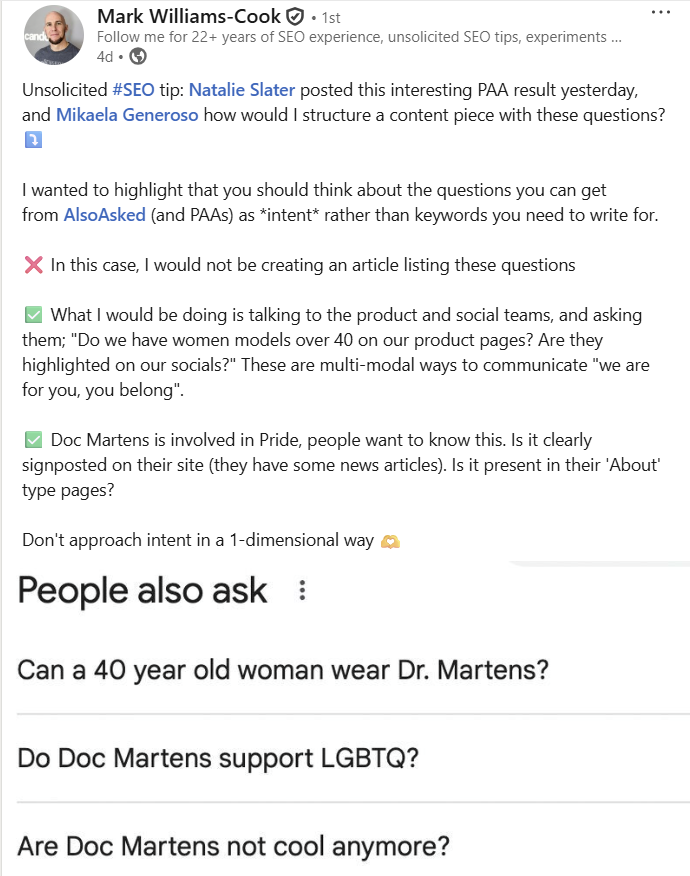
This goes further, because certain abstract ideas are conveyed more authentically through visuals.
To answer “Can a 40-year-old woman wear Doc Martens?” you should show, not tell, that they belong.
Original images are essential because they reflect high effort, uniqueness, and skill, making the content more engaging and credible.
Making products machine-readable for image vision
To make products machine-readable, every visual element must be clearly interpreted by AI systems.
This starts with how images and packaging are designed.
Products and packaging as landing pages
Ecommerce packaging must be engineered like a digital asset to thrive in the era of multimodal AI search.
When AI or search engines can’t read the packaging, the product becomes invisible at the moment of highest consumer intent.
Design for OCR-friendliness and authenticity
Both Google Lens and leading LLMs use optical character recognition (OCR) to extract, interpret, and index data from physical goods.
To support this, text and visuals on packaging must be easy for OCR to convert into data.
Prioritize high-contrast color schemes. Black text on white backgrounds is the gold standard.
Critical details (e.g., ingredients, instructions, warnings) should be presented in clean, sans-serif fonts (e.g., Helvetica, Arial, Lato, Open Sans) and set against solid backgrounds, free from distracting patterns.
This means treating physical product labeling like a landing page, as Cetaphil does.

Avoid common failure points such as:
- Low contrast.
- Decorative or script fonts.
- Busy patterns.
- Curved or creased surfaces.
- Glossy materials that reflect light and break up text.
Here’s an example:

Document where OCR fails and analyze why.
Run a grayscale test to confirm that text remains distinguishable without color.
For every product, include a QR code that links directly to a web page with structured, machine-readable information in HTML.
High-resolution, multi-angle product images work best, especially for items that require authenticity verification.
Authentic photos, where accuracy and credibility are essential, consistently outperform artificial or AI-generated images.
Dig deeper: How to make ecommerce product pages work in an AI-first world
Get the newsletter search marketers rely on.
MktoForms2.loadForm(“https://app-sj02.marketo.com”, “727-ZQE-044”, 16298, function(form) {
// form.onSubmit(function(){
// });
// form.onSuccess(function (values, followUpUrl) {
// });
});
Managing your brand’s visual knowledge graph

AI does not isolate your product. It scans every adjacent object in an image to build a contextual database.
Props, backgrounds, and other elements help AI infer price point, lifestyle relevance, and target customers.
Each object placed alongside a product sends a signal – luxury cues, sport gear, utilitarian tools – all recalibrating the brand’s digital persona for machines.
A distinctive logo within each visual scene ensures rapid recognition, making products easier to identify in visual and multimodal AI search “in the wild.”
Tight control of these adjacency signals is now part of brand architecture.
Deliberate curation ensures AI models correctly map a brand’s value, context, and ideal customer, increasing the likelihood of appearing in relevant, high-value conversational queries.
Run a co-occurrence audit for brand context
Establish a workflow that assesses, corrects, and operationalizes brand context for multimodal AI search.
Run this audit in AI Mode, ChatGPT search, ChatGPT, and another LLM model of your choice.
Gather the top five lifestyle or product photos and input them into a multimodal LLM, such as Gemini, or an object detection API, like the Google Vision API.
Use the prompt:
- “List every single object you can identify in this image. Based on these objects, describe the person who owns them.”
This generates a machine-produced inventory and persona analysis.
Identify narrative disconnects, such as a budget product mispositioned as a luxury or an aspirational item, undermined by mismatched background cues.
From these results, develop explicit guidelines that include props, context elements, and on-brand and off-brand objects for marketing, photography, and creative teams.
Enforce these standards to ensure every asset analyzed by AI – and subsequently ranked or recommended – consistently reinforces product context, brand value, and the desired customer profile.
This alignment ensures consistent machine perception with strategic goals and strengthens presence in next-generation search and recommendation environments.
Brand control across the four visual layers
The brand control quadrant provides a practical framework for managing brand visibility through the lens of machine interpretation.
It covers four layers, some owned by the brand and others influenced by it.
Known brand
This includes owned visuals, such as official logos, branded imagery, and design guides, which brands assume are controlled and understood by both human audiences and AI.

Image strategy
- Curate a visual knowledge graph.
- List and assess adjacent objects in brand-connected images.
- Build and reinforce an “Object Bible” to reduce narrative drift and ensure lifestyle signals consistently support the intended brand persona and value.
Latent brand
These are images and contexts AI captures “in the wild,” including:
- User photos.
- Social sightings.
- Street-style shots.
These third-party visuals can generate unintended inferences about price, persona, or positioning.
An extreme example is Helly Hansen, whose “HH” logo was co-opted by far-right and neo-Nazi groups, creating unintended associations through user-posted images.


Shadow brand
This quadrant consists of outdated brand assets and materials presumed private that can be indexed and learned by LLMs if made public, even unintentionally.
- Audit all public and semi-public digital archives for outdated or conflicting imagery.
- Remove or update diagrams, screenshots, or historic visuals.
- Funnel only current, strategy-aligned visual data to guide AI inferences and search representations.
AI-narrated brand
AI builds composite narratives about a brand by synthesizing visual and emotional cues from all layers.
This outcome can include competitor contamination or tone mismatches.

Image strategy
- Test the image’s meaning and emotional tone using tools like Google Cloud Vision to confirm that its inherent aesthetics and mood align with the intended product messaging.
- When mismatches appear, correct them at the asset level to recalibrate the narrative.
Factoring for sentiment: Aligning visual tone and emotional context
Images do more than provide information.
They command attention and evoke emotion in split seconds, shaping perceptions and influencing behavior.
In AI-driven multimodal search, this emotional resonance becomes a direct, machine-readable signal.
Emotional context is interpreted and sentiment scored.

The affective quality of each image is evaluated by LLMs, which synthesize sentiment, tone, and contextual nuance alongside textual descriptions to match content to user emotion and intent.
To capitalize on this, brands must intentionally design and rigorously audit the emotional tone of their imagery.
Tools like Microsoft Azure Computer Vision or Google Cloud Vision’s API allow teams to:
- Score images for emotional cues at scale.
- Assess facial expressions and assign probabilities to emotions, enabling precise calibration of imagery to intended product feelings such as “calm” for a yoga mat line, “joy” for a party dress, or “confidence” for business shoes.
- Align emotional content with marketing goals.
- Ensure that imagery sets the right expectations and appeals to the target audience.
Start by identifying the baseline emotion in your brand imagery, then actively test for consistency using AI tools.
Ensuring your brand narrative matches AI perception
Prioritize authentic, high-quality product images, ensure every asset is machine-readable, and rigorously curate visual context and sentiment.
Treat packaging and on-site visuals as digital landing pages. Run regular audits for object adjacency, emotional tone, and technical discoverability.
AI systems will shape your brand narrative whether you guide them or not, so make sure every visual aligns with the story you intend to tell.