
GEO, AI SEO, AEO – call it what you like.
The label doesn’t matter nearly as much as understanding the shift behind it.
At the center of that shift lies one idea that explains everything: AI availability – and here’s why it matters.
What is AI availability?
The idea of AI availability comes from Byron Sharp, research professor at the Ehrenberg-Bass Institute, who introduced it in a comment on one of my LinkedIn posts.
Sharp’s work underpins modern brand science and shows that growth depends on availability.
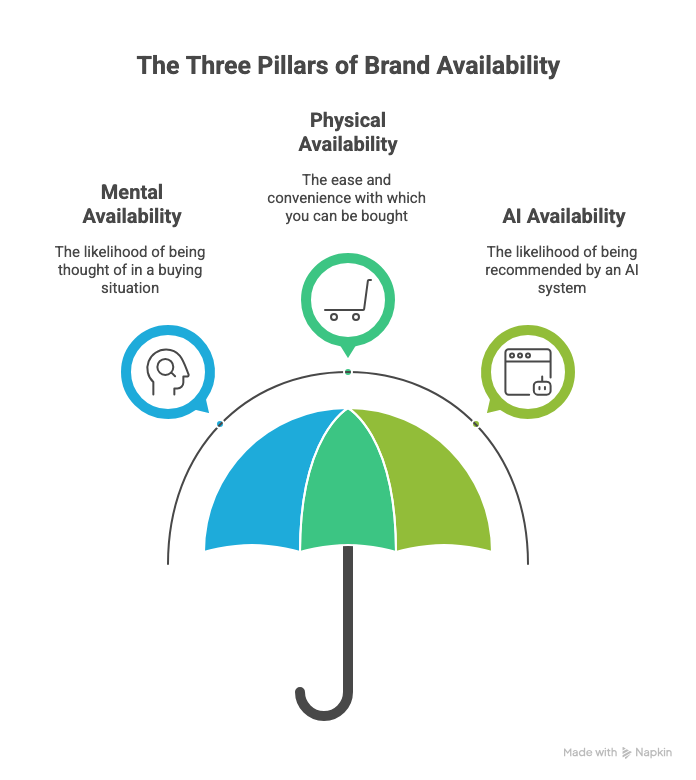
Brands grow through sales, and sales grow through two kinds of availability: mental and physical.
- Mental availability refers to the likelihood of being considered in a purchasing situation.
- Physical availability refers to the ease and convenience with which an item can be bought.
For years, these two principles have guided brand strategy.
They explain why Coca-Cola invests in constant visibility and why Amazon makes every click lead to a checkout.
But in the era of generative search, there’s now a third kind of availability marketers need to understand – the likelihood that your brand or product will be recommended by an AI system when a user is ready to buy.
That is AI availability – and it changes everything.
AI as the new influencer
If you are still thinking of AI as a technology, you are already behind.
Think of it instead as the world’s most powerful influencer.
ChatGPT alone is used by about 10% of the global adult population, according to recent research from OpenAI, Harvard, and Duke.
That makes it far more pervasive than any social media platform at a similar stage in its life cycle.
Most people do not use it to code or write poetry – they use it to make decisions.
Nearly 80% of ChatGPT conversations, the same study found, fall into three categories:
- Practical guidance.
- Seeking information.
- Writing.
In other words, people are asking AI to help them decide what to do, buy, and believe.
The study also shows that these conversations are increasingly focused on everyday decisions rather than work.
The distinction between search, research, and conversation is collapsing.

The result is simple.
AI systems are now the gatekeepers of modern discovery. They decide what information to surface and which businesses appear in front of consumers.
Forget the Kardashians. Forget influencer marketing.
If you’re invisible to AI, you’re invisible to the market.
AI is the new influencer.
From keywords to fitness signals
The SEO industry has spent two decades optimizing for how humans search with keywords – but that is changing.
Large language models (LLMs) infer meaning from context, probability, and performance.
They are scanning for what we can call fitness signals – a term from network science.
Fitness describes a product or service’s inherent ability to outcompete rivals, allowing one business to dominate a market even if others started earlier or invested more.
Think of how Google overtook Yahoo.
It wasn’t just about better search algorithms – it was a better business model built on a stronger performance attribute: relevance.
These performance attributes are what make a business fit for survival. They are the qualities that define how well you solve a problem for a customer.
AI deploys search strategies to identify which businesses solve which problems most effectively.
Because it exists to serve human needs, those same signals determine your AI availability.
Yes, AI uses search strings, fan-out queries, and reciprocal rank fusion, among many other strategies and tactics.
It doesn’t search like humans because it isn’t bound by the same cognitive and speed limitations.
Humans search by “satisficing.” Keywords + Page 1 rankings = good enough.
Machines operate on an industrial scale – searching, gathering, assessing, and recommending.
Dig deeper: Fame engineering: The key to generative engine optimization
The psychology of performance
To understand why this works, we turn to evolutionary psychology.
Geoffrey Miller, author of “Spent,” explained that humans have always been driven by two fundamental needs.
- We seek to display fitness indicators that enhance our status.
- We chase fitness cues that increase our chances of survival or pleasure.
Consumer products have evolved to meet those needs. Luxury goods signal success.
Convenience products signal control. Both deliver psychological reassurance.
AI works in a similar way. Its goal is to satisfy human intent.
When someone types a complex prompt into an LLM, the AI interprets it not as a string of keywords but as a statement of need.
It then searches its training data and live information to find the most relevant and trustworthy performance attributes that match that need.
That is why context matters so much more than content.
You are no longer competing for blue links – you are competing for cognitive inclusion in an AI’s mental model of your category.
Your job is to make your brand’s fitness and performance attributes unmissable to that model.
Get the newsletter search marketers rely on.
MktoForms2.loadForm(“https://app-sj02.marketo.com”, “727-ZQE-044”, 16298, function(form) {
// form.onSubmit(function(){
// });
// form.onSuccess(function (values, followUpUrl) {
// });
});
Category entry points and the new SEO
Category entry points are the situations, needs, and triggers that put someone in the market to buy.
In the world of GEO, these are your new keywords.
They are what users express in prompts rather than in search terms.
“Where can I find sustainable running shoes for flat feet?” is not a keyword query – it is a buying situation.
Your strategy is to:
- Understand those buying situations.
- Map them to your own performance attributes.
- Create enough context that AI can confidently associate your brand with the solution.
That means describing not only what you do, but how you do it, who you do it for, and why you are distinctive.
This isn’t new. It’s the same foundational brand positioning marketers have always needed.
What’s changed is that it now feeds the world’s most sophisticated recommender system.
Dig deeper: AI search is booming, but SEO is still not dead
A local example: The sandwich shop in Stoke
Imagine a small sandwich shop in Stoke. It’s not glamorous, serving sausage sandwiches, bacon rolls, and coffee.
The owners don’t want to be influencers. They just want customers.
How does a business like this make itself visible to AI?
Turn everyday details into data signals
The first step is to make its performance attributes explicit.
- What ingredients are used?
- Where do they come from?
- What makes the sandwiches good value?
- How long has the business served the local community?
- Where is it located?
- What is the hygiene rating?
All these details are small signals of trust and quality.
A strong website should describe them in clear, human language.
Every piece of information tells AI that:
- This business exists.
- It serves specific needs.
- It performs well in doing so.
Build reputation where AI listens
Next, build local reputation.
- Encourage reviews on Google, TripAdvisor, and social media.
- Invite local bloggers to taste and review the food.
- Issue a press release about an anniversary or charity event.
Every third-party mention adds more mutual information between your brand and the market – and that’s what AI learns from.
GEO is where good brand marketing meets intelligent technology.
Embrace both SEO and GEO
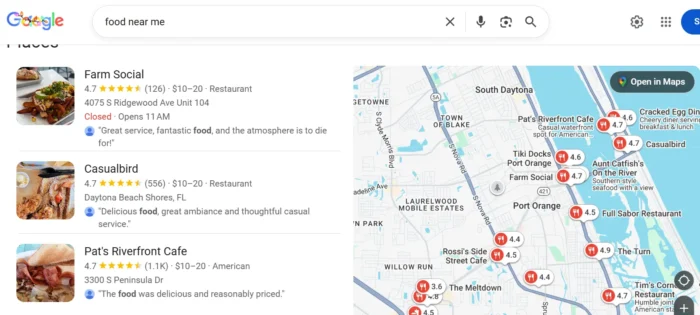
And for the “GEO is just SEO” crowd, yes, ranking on Google and in the local pack might be the best bet for increasing AI availability for this shop.
However, it might also be hosting a relaunch event and inviting 30 local bloggers and press members to secure coverage.
Both are valid tactics with multiple benefits – and you can do both.
Until Google decides what it’s doing with the 10 blue links and AI Mode, bothism is the best plan – SEO and GEO, not just one.
From PR to performance
Larger businesses apply the same logic at scale. The recent wave of acquisitions in the SEO and analytics sector is a testament to this.
- Semrush acquiring Search Engine Land.
- Ahrefs buying Detailed.com.
- Countless agencies launching their own media arms are not random expansions.
These are deliberate attempts to control information ecosystems.
Owning media outlets, communities, and data platforms increases a company’s visibility in the information that AIs learn from.
It creates an abundance of references that confirm expertise, authoritativeness, and relevance.
In traditional SEO, this is referred to as off-page optimization.
In GEO, it is strategic distribution – where performance attributes and PR meet.
Your goal is to describe what you do, while making sure others also describe it.
Fame, distinctive assets, and consistency still matter. But the audience is no longer just human.
Dig deeper: AI search relies on brand-controlled sources, not Reddit: Report
Building AI availability
To make your brand visible to machines that now mediate discovery, you need to understand how and where that visibility is built.
Start with a visibility audit
Diagnose your current presence.
Identify the category entry points most relevant to your products, and ask what prompts a user might type when they are ready to buy.
Tools such as Semrush’s AI Enterprise platform can simulate these scenarios and show where your brand appears.
Get listed where AI looks
Identify the sources that AI models reference.
Many LLMs use a mix of training data and live search, with listicles, directories, and “best of” articles among the most common data sources.
Being included in those lists is a sensible marketing strategy.
Just as supermarkets stock their own shelves with their best products, you should position your brand among the best available options.
Expand your owned ecosystem
Over time, you’ll find saturation points where every competitor appears in the same lists.
At that stage, innovation and owned media become essential.
Start your own publication, commission original research, and contribute to conversations in your category.
Create context that earns recommendations
Digital shelf space isn’t the problem. Credible context amplifies your fitness signals.
Efficient, data-led, and creative, this is GEO’s manufactured style. But its success depends entirely on having a brand worth recommending.
That’s why GEO is the outcome of proper marketing.
Still, it’s proper marketing with a specific focus: increasing the likelihood of being recommended by AI.
The future of visibility
SEO has always been about optimization.
GEO is about promotion – building and distributing enough credible, distinctive information about your business that an AI can recognize it as a trusted source.
The techniques look familiar: PR, branding, copywriting, partnerships, directories, and reviews.
The difference lies in intent. You’re not feeding a search engine – you’re training an intelligence.
This requires a new mindset.
- You’re no longer optimizing for human users who type short queries into Google. You’re optimizing for a probabilistic model that interprets human intent across millions of contexts.
- It doesn’t care about your title tags. It cares about whether you look like the right answer to a real problem.
GEO is both exciting and humbling.
It reconnects brand marketing and search after years of false division, and reminds us that while the tools evolve, the fundamentals endure.
You still need to be known, available, and distinctive.
And now your audience includes machines that think like humans but learn on their own terms.
Back to fundamentals, forward with AI
GEO is a return to marketing fundamentals seen through a new lens.
Businesses still grow by increasing availability.
Consumers still buy from the brands they notice and can easily access.
What has changed is the mediator: AI has become the primary distributor of attention.
Your task as a marketer is to make your brand’s performance attributes, category entry points, and distinctive assets visible in the data that AI consumes.
The goal hasn’t changed – to be chosen. Only the mechanics are new.
Because in the age of AI, the only brands that matter are the ones the machines remember.