Why most B2B buying decisions happen on Day 1 – and what video has to do with it
 By DynamicSEO

There’s a dangerous misconception in B2B marketing that video is just a “brand awareness” play. We tend to bucket video into two extremes:
- The “viral” top-of-funnel asset that gets views but no leads.
- The dry bottom-of-funnel product demo that gets leads but no views.
This binary thinking is breaking your pipeline.
In my role at LinkedIn, I have access to a unique view of the B2B buying ecosystem. What the data shows is that the most successful companies don’t treat video as a tactic for one stage of the funnel. They treat it as a multiplier.
When you integrate video strategy across the entire buying journey – connecting brand to demand – effectiveness multiplies, driving as many as 1.4x more leads.
Here’s the strategic framework for building that system, backed by new data on how B2B buyers actually make decisions.
The reality: The ‘first impression rose’
The window to influence a deal closes much earlier than most marketers realize.
LinkedIn’s B2B Institute calls this the “first impression rose.” Like the reality TV show “The Bachelor,” if you don’t get a rose in the first ceremony, you’re unlikely to make it to the finale.
Research from LinkedIn and Bain & Company found 86% of buyers already have their choices predetermined on “Day 1” of a buying cycle. Even more critically, 81% ultimately purchase from a vendor on that Day 1 list.
If your video strategy waits until the buyer is “in-market” or “ready to buy” to show up, you’re fighting over the remaining 19% of the market. To win, you need to be on the shortlist before the RFP is even written.
That requires a three-play strategy.
Play 1: Reach and prime the ‘hidden’ buying committee
The goal: Reach the people who can say ‘no’
Most video strategies target the “champion,” the person who uses the tool or service. But in B2B, the champion rarely holds the checkbook.
Consider this scenario. You’ve spent months courting the VP of marketing. They love your solution. They’re ready to sign.
But when they bring the contract to the procurement meeting, the CFO looks up and asks: “Who are they? Why haven’t I heard of them?”
In that moment, the deal stalls. You’re suddenly competing on price because you have zero brand equity with the person controlling the budget.

Our data shows you’re more than 20 times more likely to be bought when the entire buying group – not just the user – knows you on Day 1.
The strategic shift: Cut-through creative
To reach that broader group, you can’t just be present. You have to be memorable. You need reach and recall, both.
LinkedIn data reveals exactly what “cut-through creative” looks like in the feed:
- Be bold: Video ads featuring bold, distinctive colors see a 15% increase in engagement.
- Be process-oriented: Messaging broken down into clear, visual steps drives 13% higher dwell times.
- The “Goldilocks” length: Short videos between 7-15 seconds are the sweet spot for driving brand lift – outperforming both very short (under 6 seconds) and long-form ads.
- The “Silent Movie” rule: Design for the eye, not the ear. 79% of LinkedIn’s audience scrolls with sound off. If your video relies on a talking head to explain the value prop in the first 5 seconds, you’ve lost 80% of the room. Use visual hooks and hard-coded captions to earn attention instantly.
Dig deeper: 5 tips to make your B2B content more human
Play 2: Educate and nudge by selling ‘buyability’
The goal: Mitigate personal and professional risk
This is where most B2B content fails. We focus on selling capability (features, specs, speeds, feeds) and rarely focus on buyability (how safe it is to buy us).
When a B2B buyer is shortlisting vendors, they’re navigating career risk.
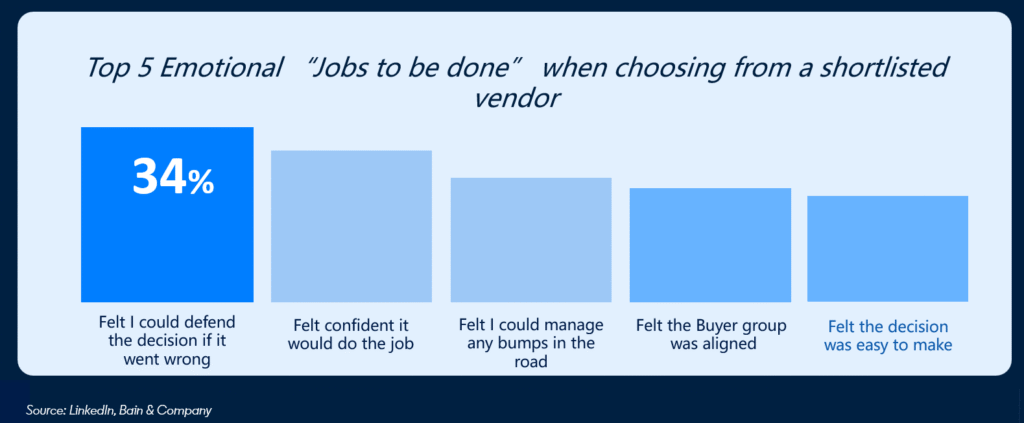
Our research with Bain & Company found the top five “emotional jobs” a buyer needs to fulfill. Only two were about product capability.
The No. 1 emotional job (at 34%) was simply, “I felt I could defend the decision if it went wrong.”
The strategic shift: Market the safety net
To drive consideration, your video content shouldn’t be a feature dump. It should be a safety net. What does that actually look like?
Momentum is safety (the “buzz” effect)
Buyers want to bet on a winner. Our data shows brands generate 10% more leads when they build momentum through “buzz.”
You can manufacture this buzz through cultural coding. When brands reference pop culture, we see a 41% lift in engagement.
When they leverage memes (yes, even in B2B), engagement can jump by 111%. It signals you’re relevant, human, and part of the current conversation.
Authority builds trust (the “expert” effect)
If momentum catches their eye, expertise wins their trust. But how you present that expertise matters.
Video ads featuring executive experts see 53% higher engagement.
When those experts are filmed on a conference stage, engagement lifts by 70%.
Why? The setting implies authority. It signals, “This person is smart enough that other people paid to listen to them.”
Consistency is credibility
You can’t “burst” your way to trust. Brands that maintain an always-on presence see 10% more conversions than those that stop and start. Trust is a cumulative metric.
Dig deeper: The future of B2B authority building in the AI search era
Get the newsletter search marketers rely on.
MktoForms2.loadForm(“https://app-sj02.marketo.com”, “727-ZQE-044”, 16298, function(form) {
// form.onSubmit(function(){
// });
// form.onSuccess(function (values, followUpUrl) {
// });
});
Play 3: Convert and capture by removing friction
The goal: Stop convincing, start helping
By this stage, the buyer knows you (Play 1) and trusts you (Play 2).
Don’t use your bottom-funnel video to “hard sell” them. Use it to remove the friction of the next step.
Buyers at this stage feel three specific types of risk:
- Execution risk: “Will this actually work for us?”
- Decision risk: “What if I’m choosing wrong?”
- Effort risk: “How much work is implementation?”
That’s why recommendations, relationships, and being relatable help close deals.

The strategic shift: Answer the anxiety
Your creative should directly answer those anxieties.
Scale social proof – kill execution risk
90% of buyers say social proof is influential information. But don’t just post a logo.
Use video to show the peer. When a buyer sees someone with their exact job title succeeding, decision risk evaporates.
Activate your employees – kill decision risk
People trust people more than logos. Startups that activate their employees see massive returns because it humanizes the brand.
The stat that surprises most leaders. Just 3% of employees posting regularly can drive 20% more leads, per LinkedIn data.
Show the humans who’ll answer the phone when things break.
The conversion combo – kill effort risk
Don’t leave them hanging with a generic “Learn More” button.
We see 3x higher lead gen open rates when video ads are combined directly with lead gen forms.
The video explains the value, the form captures the intent instantly.
- Short sales cycle (under 30 days): Use video and lead gen forms for speed.
- Long sales cycle: Retarget video viewers with message ads from a thought leader. Don’t ask for a sale; start a conversation.
Dig deeper: LinkedIn’s new playbook taps creators as the future of B2B marketing
It’s a flywheel, not a funnel
If this strategy is so effective, why isn’t everyone doing it? The problem isn’t usually budget or talent. It’s structure.
In most organizations, “brand” teams and “demand” teams operate in silos.
- Brand owns the top of the funnel (Play 1).
- Demand owns the bottom (Play 3).
They fight over budget and rarely coordinate creative.
This fragmentation kills the multiplier effect.
When you break down those silos and run these plays as a single system, the data changes.
Our modeling shows an integrated strategy drives 1.4x more leads than running brand and demand in isolation.
It creates a flywheel:
- Your broad reach (Play 1) builds the retargeting pools.
- Your educational content (Play 2) warms up those audiences, lifting CTRs.
- Your conversion offers (Play 3) capture demand from buyers who are already sold, lowering your CPL.
The brands that balance the funnel – investing in memory and action – are the ones that make the “Day 1” list.
And the ones on that list are the ones that win the revenue.